
Architectural installation of hand-printed Chanderi and cotton textiles requires gallery-grade mounting frameworks. Textiles are tension-stretched over custom-milled bevelled cedar stretcher bars backed with unbleached cotton lining and acoustic wool felt. Conservation demands strict museum illumination protocols (under 50 Lux, zero UV), humidity buffering (45%–55% RH), and reversible perimeter mounting without permanent adhesives.
At a Glance: Key Takeaways
- Stretcher Frame Architecture: Beveled kiln-dried western red cedar or quarter-sawn teak with mortise-and-tenon corners.
- Bevel Profile: 8-degree inward bevel preventing timber face contact and eliminating edge impression lines.
- Acoustic Sub-Core: 25mm dense uncarded sheep wool felt or needle-punched polyester acoustic blanket (NRC 0.85).
- Fastening Standard: Marine-grade Monel or 316 stainless steel staples driven through twill cotton stay tape.
- Illumination Threshold: Strictly capped at 50 Lux maximum illumination with zero ultraviolet (<75 microwatts/lumen).
- Pest Remediation: Non-toxic anoxic nitrogen or argon fumigation for moth and carpet beetle control.
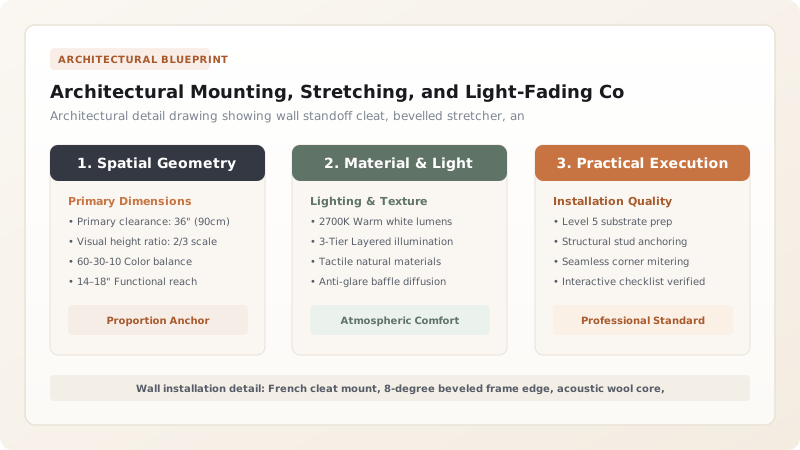
Stretcher Frame Engineering: Bevels and French Cleats
Stretching delicate Chanderi silk-cotton textiles requires specialized frame geometry. If fabric is pulled over a standard flat-faced wooden frame, the sharp inner edge of the wood creates a visible permanent crease, and fabric abrasion occurs whenever humidity fluctuates.
Master conservators mill frames with an 8° inward bevel along the front face, ensuring the fabric only contacts the rounded outer perimeter lip. The frames are constructed from knot-free western red cedar or seasoned teak with mitered, keyed mortise-and-tenon corners. The completed panels mount to masonry walls using interlocking aluminum or hardwood French cleats, creating a 20mm rear air gap that prevents wall moisture from wicking into the fabric.
Tensioning Protocols and Acoustic Wool Core Integration
Textile tensioning must be executed from the center outward. The fabric is never stapled directly; artisans stitch a protective strip of heavy unbleached cotton twill tape along the textile perimeter margin.
Installers pull opposite centers with canvas stretching pliers, driving stainless steel staples through the twill tape into the rear frame face in alternating cross-patterns. Inside the frame cavity, behind an unbleached muslin interlining, installers pack a 25mm pad of pure pressed wool felt. This transforms the ornamental historic textile panel into a high-performance acoustic absorber (Noise Reduction Coefficient NRC > 0.85), suppressing room flutter echoes while providing luxurious tactile cushioning.
Conservation Physics: Lux Thresholds and UV Filtration
Natural botanical dyes (especially indigo, madder, and turmeric) are susceptible to photochemical degradation. High-energy ultraviolet photons break the conjugated double bonds of the chromophore molecules, causing irreversible color fading and weakening cellulose fibers.
Museum-grade residential conservation enforces strict illumination parameters: lighting must utilize high-CRI (Color Rendering Index > 95) warm LED fixtures with zero UV emissions below 400nm. Ambient light levels at the fabric face must be capped between 50 and 75 Lux. Direct sunlight exposure is completely forbidden; all adjacent windows must feature solar control window film or 99% UV-blocking laminated architectural glazing.
Environmental Criteria for Architectural Textile Installations
Use this reference table to calculate exact physical dimensions, ratios, and specifications before purchasing:
| Environmental Parameter | Museum Conservation Standard | Acceptable Residential Range | Critical Damage Threshold |
|---|---|---|---|
| Light Exposure (Illuminance) | 50 Lux maximum | 75 to 100 Lux (timed occupancy) | > 150 Lux (rapid color fading) |
| Ultraviolet Radiation | < 75 µW/lumen (near zero) | < 10 µW/lumen (LED only) | > 75 µW/lumen (fiber embrittlement) |
| Relative Humidity (RH) | 45% to 55% constant | 40% to 60% with gentle cycles | < 30% (desiccation) / > 70% (mold) |
| Temperature Range | 18°C – 22°C | 20°C – 24°C | > 28°C (accelerates chemical decay) |
| Mounting Reversibility | 100% stitch-mounted; zero adhesive | Twill tape staple hem | Adhesive glues / spray bonding (RUINOUS) |
Practical Constraints
Every successful decoration project must account for physical and environmental constraints:
Clothes moths (Tineola bisselliella) attacking natural wool felt and cotton textile backings
Mitigation: Incorporate non-toxic cedarwood oil sachets behind the panel and treat wool felt with borate mineral insect retardants.
Execution Blueprint & Craftsmanship Sequence
Execute this professional sequence to achieve flawless results without backtracking:
Mill 8-Degree Bevel on Cedar Stretcher Bars
Profile kiln-dried cedar frame stock on shaper with 8-degree inward face bevel and eased 3mm radius outer lip.
Assemble Mitered Keyed Mortise Frame Corners
Join corners with loose hardwood keys and check diagonal measurements to verify rectangular squareness.
Insert 25mm Acoustic Wool Felt and Muslin Barrier
Fit natural sheep wool felt inside frame cavity; cover with unbleached cotton muslin stapled around back.
Stitch Cotton Twill Reinforcement Tape to Textile Margins
Hand-sew unbleached 25mm cotton twill tape around perimeter edges of Chanderi textile using fine cotton thread.
Tension-Staple Textile from Center to Corners
Tension fabric using canvas pliers, driving stainless steel staples through twill tape into rear frame face in diamond pattern.
Hang on Aluminum French Cleat Wall System
Fasten interlocking French cleats to masonry wall; hang completed acoustic panel ensuring 20mm rear ventilation gap.
Common Mistakes & Countermeasures
Avoid these costly errors that compromise aesthetics, ergonomics, and budget:
Gluing the textile panel onto plywood or MDF substrate with spray adhesives
Illuminating the textile panel with halogen or incandescent spotlights
Project Execution Checklist
Track your physical progress. Checkboxes persist automatically on this device:
Frequently Asked Questions
Can tension-mounted textile panels be taken down for laundering?
They should not be wet-laundered. Because the textiles are hand-sewn to twill tape, they can be un-stapled by a conservator if necessary, but maintenance is strictly performed in situ via micro-vacuuming with a mesh screen.
Why is an 8-degree inward bevel essential on the stretcher frame?
The bevel ensures that the stretched fabric only touches the outer wooden rim. Without the bevel, the flat wood face touches the back of the textile, leaving an unsightly permanent dark ghost line where atmospheric dust collects along the wood edge.


