
Hand-pierced fretwork spandrels (chrili) and heavy corbel brackets represent the artisanal apex of Tbilisi timber engineering. Master carpenters hand-sawed intricate lace patterns into 25 mm chestnut and linden planks, integrating them into cantilevered post-and-beam frameworks using traditional pegged mortise-and-tenon joints that withstand Caucasian seismic tremors.
At a Glance: Key Takeaways
- Carving Craft: Chrili (pierced openwork lace fretwork executed with scroll and bow saws)
- Preferred Hardwood: Caucasian Sweet Chestnut (Castanea sativa) for weather resistance
- Structural Brackets: Modillons (curved cantilever corbels carved with ram horns and volutes)
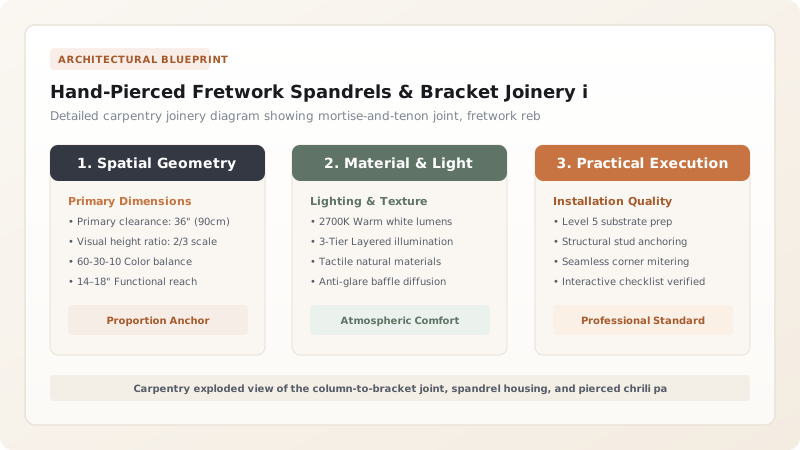
- Joinery Detail: Draw-bored mortise-and-tenon joints secured with hardwood oak dowels
The Woodcarver’s Craft: Durglebi Guilds
In 19th-century Tbilisi, architectural woodcarving was organized under powerful craft guilds (amkari). Master carpenters and carvers, known as durglebi, underwent seven-year apprenticeships to master timber selection, geometric drafting, and precision scrollwork.
Unlike Western Victorian scrollwork produced by steam-powered mechanical jigsaw mills, every single Tbilisi balcony panel was carved by hand. Artisans drilled starter holes with hand augers and threaded thin steel bow-saw blades through each cavity, cutting compound curves with rhythmic, calligraphic fluidity.
Anatomy of the Modillon Corbel Bracket
The structural bridge between the flat exterior masonry wall and the projecting balcony is the heavy carved bracket or modillon. Typically cut from seasoned Caucasian oak timbers measuring 20 x 25 cm, the bracket is shaped into an S-curve or multi-stepped volute.
Carvers decorated these heavy structural timbers with ancient Caucasian zoomorphic emblems—most prominently the stylized curled horn of the mountain ram (jikhvi), representing strength and physical protection. The top face of the bracket features a precision housing pocket into which the horizontal balcony joist rests, preventing lateral slipping.
Fretwork Geometry: The Spandrel and Arch
Between adjacent balcony columns, carvers installed arched spandrel screens that frame the street views like theatrical proscenium arches. The geometry of these pierced panels is a masterwork of mathematical subdivision.
Artisans mapped out concentric circles, interlaced gothic trefoils, and Islamic starbursts using brass compasses and bone scribers. The wood between the lines was excised, leaving delicate bridges barely 8 to 12 mm wide. Despite this extreme delicacy, the panels remain surprisingly strong because carvers aligned the primary stress lines parallel to the natural longitudinal wood grain.
Pegged Joinery and Seismic Resilience
The Caucasus region sits atop active tectonic fault lines; rigid structures with brittle metal fasteners often fracture during tremors. Tbilisi balcony carpentry relies on draw-bored mortise-and-tenon joints secured exclusively with seasoned oak dowels (chirebi).
The offset dowel holes pull the tenon shoulders tightly into the mortise under dynamic mechanical tension. During an earthquake, the entire timber balcony frame can sway, flex, and dissipate kinetic seismic energy without shearing or pulling out of the brick wall facade.
Wood Species Performance in Caucasian Balcony Carpentry
Use this reference table to calculate exact physical dimensions, ratios, and specifications before purchasing:
| Wood Variety | Workability for Chrili | Rot & Moisture Resistance | Structural Role |
|---|---|---|---|
| Caucasian Chestnut (Castanea sativa) | Excellent; fine grain cuts crisply without tearing | Outstanding; rich in natural tannic acids | Primary fretwork spandrels, balustrades, and deck planks |
| Caucasian Oak (Quercus macranthera) | Challenging; dense and hard on hand tools | Exceptional; impervious to fungal decay | Load-bearing cantilever joists, corbels, and dowel pins |
| Caucasian Linden (Tilia caucasica) | Superior; buttery soft texture allows microscopic cuts | Low; rots quickly if exposed to direct rain | Sheltered courtyard ceiling medallions and interior fretwork |
| Scots Pine (Pinus sylvestris) | Moderate; resin channels can gum fine saws | Good when treated with natural pine tar | Balcony roof rafters, purlins, and window sash frames |
Practical Constraints
Every successful decoration project must account for physical and environmental constraints:
Labor-intensive manual production times.
A single intricate spandrel arch requires 40 to 60 hours of continuous hand-sawing by a master craftsman. Mitigation: Utilize modern precision waterjet or CNC pre-routing for rough bulk waste, followed by meticulous hand-tool gouge finishing.
Severe air pollution and soot accumulation in urban historic districts.
Sulfur and particulate matter from traffic adhere to the intricate lace cavities, accelerating surface decay. Mitigation: Wash historic carvings annually with low-pressure warm water and neutral conservation soap, followed by oil resealing.
Execution Blueprint & Craftsmanship Sequence
Execute this professional sequence to achieve flawless results without backtracking:
Chestnut Timber Seasoning and Resawing
Season quarter-sawn Caucasian chestnut planks for 24 months, resawing to uniform 25 mm thicknesses for fretwork panels.
Full-Scale Pounce Pattern Transfer
Draw the geometric lace design on parchment, prick outlines with needles, and pounce with charcoal dust onto the planed wood face.
Pilot Hole Hand-Augering
Drill clean 6 mm entry holes through every negative-space cavity using a hand brace and spoon bit without splitting delicate bridges.
Bow-Saw Pierced Hand-Cutting
Thread a fine German steel scroll blade through each pilot hole, hand-sawing intricate curves along scribed guidelines.
Chisel Chamfering and Undercutting
Chamfer the front edges of the pierced fretwork with small curved gouges, creating soft shadow lines that enhance optical depth.
Modillon Bracket Sculpting
Hew 20 x 25 cm oak corbels using adzes and gouges, sculpting stylized ram-horn volutes and mortise housing pockets.
Draw-Bore Mortise Assembly
Assemble columns, brackets, and spandrel panels, driving tapered oak dowels through offset holes to draw joints dead-tight.
Walnut Oil and Pigment Impregnation
Soak completed openwork assemblies in hot boiled Caucasian walnut oil, finishing with breathable mineral linseed paint.
Common Mistakes & Countermeasures
Avoid these costly errors that compromise aesthetics, ergonomics, and budget:
Cutting fretwork across short cross-grain sections.
Fastening exterior fretwork panels with modern drywall screws or steel nails.
Project Execution Checklist
Track your physical progress. Checkboxes persist automatically on this device:
Frequently Asked Questions
What tools did 19th-century Georgian craftsmen use to cut this lace?
Craftsmen used a specialized handheld bow saw (German: Laubsäge or Georgian: Khelis Kherkhi) fitted with hair-thin steel blades, spoon-bit hand augers for pilot holes, and a set of razor-sharp curved gouges and v-parting chisels.
Why is the ram's horn such a common motif on Tbilisi brackets?
The curled horn of the Caucasian mountain ram (jikhvi) is an ancient pagan and Christian protective symbol across the Caucasus, representing masculine strength, resilience, abundance, and guardianship over the domestic threshold.
Can broken fretwork pieces be repaired without replacing the whole panel?
Yes. Master conservators use surgical wood splices, scarfing matching seasoned chestnut patches into the damaged section with reversible hide glue or conservation-grade epoxy, carved by hand to match adjacent contours.
Why didn't builders use cast iron instead of wood like in Victorian England?
Georgia possessed abundant ancient hardwood forests in the Caucasus mountains but lacked large industrial iron foundries until late in the 19th century. Woodcarving was an ancient, highly revered folk tradition that local artisans took immense pride in perfecting.


