Edge grading and stone sorting is the critical preparatory phase of Provençal calade paving. Artisans hand-sort naturally tumbled Durance river pebbles (galets) and quarried Luberon limestone shards by geometric thickness, length-to-depth ratios, and chromatic hues. Calibrating stones into uniform sizing classes guarantees consistent vertical bedding depth (pose sur chant) and allows intricate mosaic patterns.
At a Glance: Key Takeaways
- Pebble Sourcing: Alluvial floodplains and ancient gravel terraces of the Durance River
- Limestone Variety: Urgonian and Barremian fine-grained limestone from Luberon quarries
- Sorting Gauge Classes: Grade 1 (40–60 mm), Grade 2 (60–90 mm), Grade 3 (90–120 mm length)
- Edge Thickness: Uniform 25–45 mm thickness along the vertical bedding axis
- Color Spectrum: Alpine quartz white, slate blue-grey, ochre cream, and basalt black
Geological Journey: The Fluvial Crucible of the Durance River
The material soul of the Provençal calade begins high in the crystalline massifs of the Écrins and the limestone plateaus of the Queyras. From these alpine heights, the roaring Durance River flows south toward the Mediterranean, carrying vast volumes of eroded rock fragments through its turbulent waters. Over millennia of relentless hydraulic tumbling, sharp boulders were battered and smoothed into the legendary galets de la Durance.
Microscopically, these river stones represent the toughest rocks in the alpine geological column. Only the densest, most quartz-rich limestones, metamorphic quartzites, and fine-grained granites could survive the hundreds of miles of grinding fluvial transport without disintegrating into sand. When gathered from ancient river terraces by Provençal masons, these pebbles offered an indestructible building material capable of withstanding centuries of iron-rimmed carriage wheels and alpine winters.
Morphology: The Science of the Discoid Pebble
A successful calade depends entirely on geometric shape discrimination. An amateur might assume that any rounded pebble from a riverbank is suitable for paving. In traditional French masonry, however, round or spherical rocks—termed *galets ronds* or "cannonballs"—are strictly forbidden in vertical paving.
A spherical stone possesses only a tiny point of contact with its neighbors; when subject to vehicular shear, it rotates within the sand bed and pops out. The master caladeur searches exclusively for discoid pebbles (flattened ellipsoids). These stones possess two broad, relatively flat parallel faces and a tapered edge. When set vertically on edge, these broad lateral faces press tightly against the adjacent stones, creating massive surface friction that locks the entire pavement into an immovable, self-compressing mechanical web.
The Calibrating Gauge: Sorting by Size and Thickness
Before a single stone can be laid into the ground, tons of raw gravel must undergo rigorous manual calibration. In traditional workshops, apprentice caladeurs worked with wooden sorting gauges (*gabarits de triage*). Stones were screened through progressive wooden slats to isolate uniform size classes.
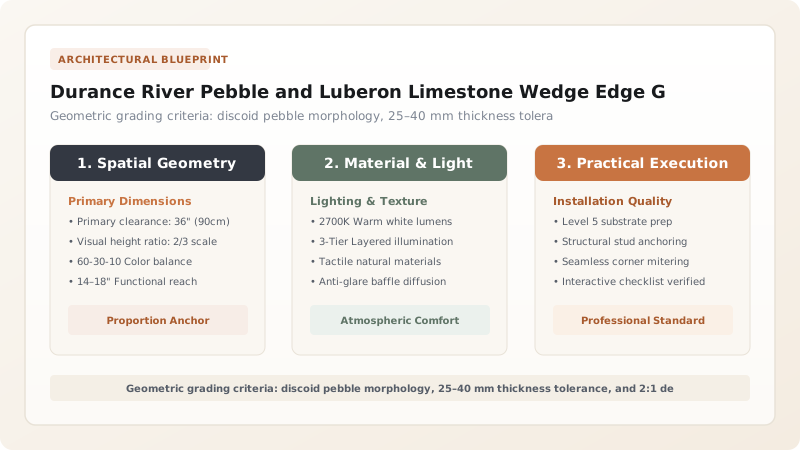
The critical dimension is not merely length, but thickness. All stones in a given paving row must have a uniform thickness along their vertical bedding plane—typically calibrated between twenty-five and forty millimeters. If a thick, bulbous stone is forced into a row of slender pebbles, it creates wide, irregular joint gaps that weaken the lateral interlock. By sorting stones into calibrated batches, the caladeur ensures that every row forms a razor-straight, unbroken line of stone heads across the courtyard.
Chromatic Orchestration: Painting with Alpine Mineral Hues
Beyond structural engineering, the grading of Durance river pebbles and Luberon limestone is a sophisticated aesthetic art form. Because the Durance drains dozens of distinct geological strata, its pebbles encompass an astonishing chromatic spectrum. Master caladeurs washed their graded stones to reveal their true saturated colors, sorting them into dedicated wooden bins.
With this natural mineral palette, the caladeur acted as an artist. Pure white alpine quartzite pebbles were reserved for sharp geometric borders, rosettes, solar wheels (*roues solaires*), and family initials. Deep slate-blue and carbon-grey siliceous limestones formed high-contrast background fields, while golden-honey Luberon limestone wedges provided rustic, slip-resistant perimeter bands. This chromatic harmony transforms utilitarian agricultural courtyards into permanent, weather-resistant works of fine art that celebrate the geology of Provence.
Calade Stone Grading Standards, Morphologies & Aesthetic Applications
Use this reference table to calculate exact physical dimensions, ratios, and specifications before purchasing:
| Stone Grade & Type | Length / Depth / Thickness | Geometric Morphology | Bearing Capacity & Traction | Architectural Role in Calade |
|---|---|---|---|---|
| Grade 1 Fine River Pebble | 50 x 70 x 25 mm | Flat oval ellipsoid (Discoid) | Foot traffic; smooth walking comfort | Intricate floral rosettes and courtyard thresholds |
| Grade 2 Standard Galet | 70 x 100 x 35 mm | Tapered elongated river stone | Medium traffic; exceptional interlock | Field background paving and patio floors |
| Grade 3 Heavy Limestone Wedge | 90 x 130 x 45 mm | Sharp-cleaved wedge with flat top | Heavy vehicular and equestrian traffic | Village street inclines and carriage mas entries |
| Contrasting White Quartzite | 60 x 80 x 30 mm | Naturally bleached river quartz | High hardness; striking visual contrast | Mosaic guiding lines, dates, and heraldic initials |
Practical Constraints
Every successful decoration project must account for physical and environmental constraints:
High Manual Labor Intensity and Physical Strain of Hand-Sorting Tons of River Stone
Sorting 10 metric tons of river stone by hand takes hundreds of artisan hours, driving project costs. Mitigation: Construct sloped mechanical sorting tables fitted with sequential wooden bar grates to pre-sort sizes.
Environmental Extraction Restrictions on Natural French Riverbeds
Mining stones directly from active river courses is strictly illegal under French ecological conservation laws. Mitigation: Source certified alluvial stones from commercial gravel quarries operating on historic tertiary river terraces.
Execution Blueprint & Craftsmanship Sequence
Execute this professional sequence to achieve flawless results without backtracking:
Raw Quarry Material Receipt and Initial Washing
Receive bulk shipments of un-screened Durance river cobbles and hosedown mounds with clean water to strip silt and reveal hidden rock colors.
Bar-Riddle Primary Screening
Shovel stones across an inclined bar riddle (grille de triage) set at 50 mm and 120 mm spacing, eliminating fine gravel and unusable oversized rocks.
Manual Shape and Flatness Discrimination
Sort remaining stones by hand, selecting flattened oval discoids while setting aside spherical balls for wall construction.
Cleaving Luberon Limestone Shards (Moellons)
Take dense Luberon quarry limestone slabs and cleave along bedding fissures using a 3-pound spalling hammer, creating long, narrow wedge stones.
Chromatic Sorting and Color Separation
Sort pebbles by mineral color into separate wooden crates: grey-blue marl, cream limestone, rosy pink granite, and chalk-white quartz.
Thickness and Depth Calibration
Test pebbles against a wooden slot gauge (gabarit) to verify uniform thickness (30–40 mm) ensuring equal joint spacing during edge-setting.
Batch Stacking at the Paving Workface
Transport sorted crates to the paving zone, arranging colors and sizes within arm’s reach of the kneeling caladeur.
Common Mistakes & Countermeasures
Avoid these costly errors that compromise aesthetics, ergonomics, and budget:
Using perfectly spherical "cannonball" round river stones for edge-setting
Mixing stones of wildly varying vertical depths (e.g., 40 mm and 120 mm) in the same section
Failing to wash organic clay and loam off river pebbles before bedding
Project Execution Checklist
Track your physical progress. Checkboxes persist automatically on this device:
Frequently Asked Questions
Why are Durance river pebbles (galets de la Durance) so famous in French masonry?
The Durance River is a fierce alpine torrent that drains the Southern Alps into the Rhône. For hundreds of thousands of years, glaciers and torrential river flows tumbled hard alpine quartzites and limestones against one another, polishing them into extraordinarily dense, smooth, rounded pebbles that resist vehicular crushing and extreme freeze-thaw cycles.
How can a mason distinguish between a good calade stone and a bad stone?
A superior calade pebble is flat, elongated like an almond or mango, and has a uniform thickness across its body with a slightly tapered bottom that wedges firmly into sand. A bad stone is completely round like an orange (it will roll under traffic) or paper-thin and brittle (it will snap in half under the wooden rammer).
What colors are naturally available in Durance river stone deposits?
Due to the diverse geology of the Alps, Durance deposits contain a rich chromatic palette: creamy-white quartz, slate-blue siliceous limestones, purplish-red volcanic rhyolites, and warm honey-ochre sandstones, allowing caladeurs to create complex graphic mosaics without synthetic pigments.