Traditional Flemish Kortrijk linen wall coverings represent the historic pinnacle of European textile wall decoration, originating in the River Lys (Leie) basin of West Flanders. Celebrated since the Middle Ages as "The Golden River" for its low-lime, iron-free water that naturally bleached and retted flax without weakening its cellular integrity, Kortrijk produced ultra-long-staple linen yarn. Woven on dense Jacquard looms into lustrous damasks and textured plain weaves, these wallcoverings provide exceptional dimensional stability, acoustic absorption (NRC 0.30–0.50), and natural indoor humidity buffering when mounted on breathable lime or plaster walls with starch adhesives.
At a Glance: Key Takeaways
- Geographic Epicenter: Kortrijk (Courtrai) & River Lys Basin, West Flanders, Belgium
- Primary Botanical Fiber: Long-staple flax bast fiber (Linum usitatissimum)
- Traditional Retting Medium: Slow-flowing anaerobic River Lys water (historically) and dew-field retting
- Weaving Typologies: Dense Jacquard floral damask, satin-striped, and fine slub plain weaves
- Architectural Mounting: Non-woven breathable backing with methylcellulose/wheat starch paste
In-Depth Guides in this Directory
Explore specialized subtopic blueprints, technical dimensions, and execution checklists:
Lys River-Retted Long-Staple Flax Fiber Spinning for Architectural Linen
Technical guide to Lys river retting, mechanical scutching, hackling pin grading, and fine wet-spinning of long-staple line flax for architectural wallcoverings.
Dense Jacquard Damask Loom Weaving and Natural Grass Bleaching for Linen Wallcoverings
In-depth analysis of Jacquard damask loom weaving, warp/weft density control, historic meadow grass bleaching, and calendering chatoyancy in Flemish linen wallcoverings.
Breathable Paste Wall Installation and Acoustic Buffering of Flemish Linen
Professional installation manual for Flemish linen wallcoverings. Covers non-woven backing, breathable starch adhesives, double-cut seams, and acoustic reverberation control.
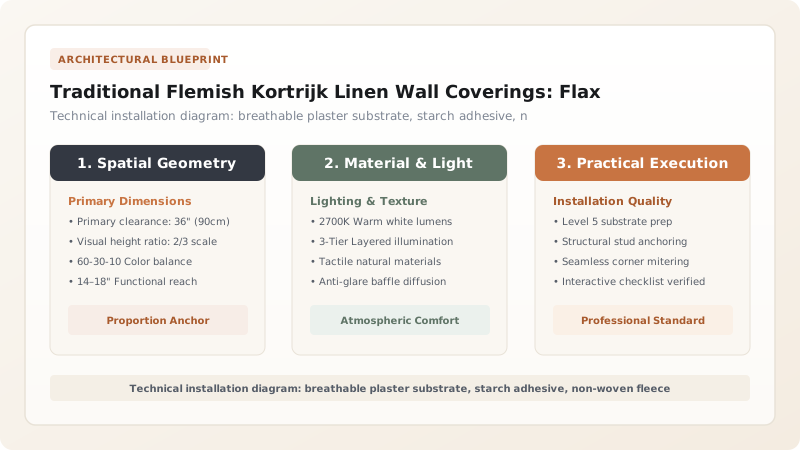
The Golden River: Kortrijk's Flax Heritage & Guild Standards
For over eight centuries, the historic city of Kortrijk (Courtrai) in the Flemish province of West Flanders has served as Europe’s indisputable capital of luxury flax cultivation and linen textile craftsmanship. Threading through the lush alluvial lowlands of the Franco-Belgian border, the River Lys—celebrated worldwide as De Gouden Rivier ("The Golden River")—provided the precise hydrological and biochemical conditions necessary to produce the world’s finest long-staple flax. During the 19th and early 20th centuries, the river surface was virtually covered with floating wooden retting crates (hekkens), filled with harvested flax bundles anchored against the gentle current. The slow-moving, peat-filtered, iron-poor water allowed anaerobic bacteria to digest the intercellular pectins without discoloring or degrading the cellulose fibers, turning the crop into a shimmering, lustrous blonde fiber prized by master weavers across the globe.
The Flemish linen guild traditions codified stringent standards for architectural textiles. Unlike utilitarian apparel or table linen, wall coverings demanded absolute dimensional stability, uniform yarn diameters, and an impeccable lightfastness that could withstand centuries of interior exposure. Kortrijk’s master weavers engineered specialized looms capable of handling high-density warps of combed line flax, establishing a legacy that adorned royal palaces, guildhalls, and grand townhouses throughout the Low Countries and across Europe. Today, this craft survives in specialized Flemish mills that merge historical knowledge with cutting-edge architectural finishing, preserving the unmatched sensory warmth of authentic flax.
Botanical Bast Anatomy: Fiber Extraction & Dew Retting
Linen is derived from the bast (phloem) tissues of the annual flowering plant Linum usitatissimum. Unlike cotton, which consists of single-celled seed hairs, flax fibers are multi-cellular composite bundles running the full height of the plant stem, often reaching lengths between 60 and 100 centimeters. These long bast fibers, known in the trade as "line flax," possess remarkable tensile strength—nearly three times that of cotton—and a high crystalline cellulose content (up to 75–80%) organized in thick spiral fibrils. Between these cellulose fibrils lie natural waxes, hemicellulose, and pectins that impart linen's characteristic crisp hand, cool tactile touch, and subtle natural sheen.
To obtain these fibers without mechanical fracture, the flax is never mown; instead, it is pulled up by the roots using specialized pulling machines, preserving the full staple length. Following pulling, the crop undergoes retting (rotting), the enzymatic process that dissolves the calcium pectate glue bonding the fiber bundles to the inner woody core (shive). While historical water retting in the River Lys was phased out for ecological river conservation, contemporary Flemish producers perfected dew retting (dauwroten). The pulled flax stalks are laid out in parallel swaths across agricultural fields, where diurnal cycles of nocturnal dew, morning fog, and afternoon sunshine foster micro-fungi (primarily Cladosporium herbarum) that gently break down pectins over several weeks. Skilled agronomists turn the swaths with tractor-mounted flippers until the fibers cleanly separate from the core, achieving the coveted silvery-grey and oatmeal patinas intrinsic to natural linen.
Jacquard Damask Weaving & Historic Meadow Bleaching
Once scutched and combed through progressive steel hackling pins to separate the short tow fibers from the silky line flax, the long-staple fibers are wet-spun into high-tensile yarns. In Flemish mills, these yarns are warped onto computer-driven Jacquard looms—the direct technological descendants of Joseph-Marie Jacquard’s 1804 punched-card innovation. In Jacquard damask weaving, the pattern and background are created simultaneously through contrasting weave structures, typically alternating warp-faced satin with weft-faced sateen. Because the warp threads reflect light longitudinally while the weft threads reflect light transversely, the fabric displays shifting, iridescent floral arabesques, acanthus scrolls, and architectural strapwork that appear and disappear as the viewer moves through the room.
Historically, the finishing of Kortrijk linen relied on "grass bleaching" or meadow bleaching (blekerijen). Huge bolts of freshly woven ecru damask were laid flat across manicured grassy meadows surrounding Flemish towns, where exposure to sunlight, atmospheric ozone, and moisture generated mild natural peroxides that gradually whitened the linen without harsh chemicals. Modern Flemish architectural linens maintain this gentle ethos through closed-loop, oxygen-based enzymatic bleaching that purifies the fiber while preserving its natural wax envelope. The woven fabric is then passed through heavy steel and cotton calendering rollers under immense hydraulic pressure, a process that flattens the cylindrical yarn cross-sections to amplify light reflection, creating a permanent, silky chatoyancy.
Architectural Wall Application & Acoustic Dampening
Installing authentic Flemish linen on interior walls requires a fundamental departure from standard vinyl or paper hanging methodologies. Natural flax is highly hygroscopic, capable of absorbing up to 20% of its dry weight in atmospheric moisture before feeling damp to the touch. In an interior environment, an unbacked linen panel will expand laterally during humid summer days and contract during dry winter heating cycles. To eliminate this movement while maintaining vapor breathability, premier Flemish manufacturers laminate the woven textile to a spunbonded, non-woven cellulose-polyester fleece backing. This backing imparts complete dimensional stability, allowing the material to be installed using the modern "paste-the-wall" technique without soaking or expanding.
The installation substrate must be breathable, smooth, and alkalized with a dedicated acrylic-free penetrating primer. Professional installers apply a heavy-bodied, low-water methylcellulose and starch paste directly to the plaster wall with a microfiber roller. The linen drops are hung vertically under zero horizontal tension and smoothed into place with soft, natural horsehair brushes to avoid crushing the delicate woven relief. Adjacent drops are overlapped by 30 millimeters and double-cut through both layers with a surgical-grade blade, creating imperceptible, butt-jointed seams. Once installed, the fibrous matrix acts as a high-performance acoustic buffer: sound waves penetrate the porous surface where friction between individual flax fibrils dissipates acoustic energy, dramatically reducing flutter echo, reverberation time, and ambient room noise.
Weave Typologies & Performance Specifications for Flemish Linen Wall Coverings
Use this reference table to calculate exact physical dimensions, ratios, and specifications before purchasing:
| Weave Structure | Yarn Construction | Visual Finish | Acoustic NRC | Optimal Application |
|---|---|---|---|---|
| Jacquard Damask | High-twist combed line flax | Reversible satin-matte botanical relief | 0.35–0.45 | Formal dining rooms, salons, historical reception halls |
| Dense Plain Weave | Medium-twist linen with natural slubs | Tactile, earthy organic texture with subtle sheen | 0.30–0.40 | Residential living spaces, libraries, boutique hospitality |
| Satin Banded Linen | Ultra-fine double-ply combed yarn | Linear iridescent luster and vertical elongation | 0.25–0.35 | High-ceilinged corridors, bedrooms, executive suites |
| Acoustic Felt-Backed Linen | Open-weave flax face on needlefelt | Deep textured face with matte light absorption | 0.50–0.65 | Home theaters, listening rooms, boardrooms, recording spaces |
| Grass-Bleached Sheer | Fine single-spun bleached line flax | Translucent, crisp, luminous parchment feel | 0.20–0.30 | Stretched fabric wall panels, recessed alcoves, folding screens |
Practical Constraints
Every successful decoration project must account for physical and environmental constraints:
High hygroscopic expansion and contraction of natural unbacked flax fibers under RH shifts
Unbacked linen stretches in humid summers and contracts in dry winters, risking slack bulges or seam splits. Mitigation: Laminate the linen to a dimensionally stable, breathable non-woven fleece backing prior to installation.
Inherent color variations and flax seed husk flecks across different harvest batches
Adjacent fabric drops can show subtle tonality shifts, creating visible paneled banding on continuous walls. Mitigation: Sequence all roll bolts sequentially according to loom run numbers and reverse alternate drops if specified.
Execution Blueprint & Craftsmanship Sequence
Execute this professional sequence to achieve flawless results without backtracking:
Wall Substrate Evaluation & Pre-Treatment
Ensure plaster or drywall substrate is fully cured, smooth, dust-free, and neutral in pH (7–8). Apply a breathable penetrating wall primer to equalize surface porosity.
Linen Roll Inspection & Sequencing
Unroll all bolts of Flemish linen, inspect for loom irregularities or color shading under bright daylight, and number cuts in continuous sequence from left to right.
Plumb Line Snapping & Layout Planning
Establish a true laser or plumb-bob vertical line 2 cm narrower than the roll width from an inconspicuous corner to prevent seams falling on prominent eye-level focal points.
Adhesive Formulation & Application
Mix heavy-duty methylcellulose adhesive enriched with wheat starch. Apply an even 1 mm film directly to the wall using a medium-nap microfiber roller (paste-the-wall method).
Hanging & Alignment Under Zero Tension
Gently position the top of the linen drop against the ceiling line, allowing 50 mm excess for trimming. Align edges along the vertical plumb line without stretching or pulling horizontally.
Smoothing with Horsehair Wallpaper Brushes
Smooth the fabric from the center outwards and downwards using a soft horsehair wallpaper brush. Never use hard plastic or metal smoothing blades that crush flax fibers.
Double-Cut Seam Splicing
Overlap adjacent linen drops by 30 mm. Cut through both layers simultaneously using a precision surgical blade against a 2-meter stainless steel straightedge, discarding waste strips.
Perimeter Trimming & Natural Air-Curing
Trim excess top and bottom edges with fresh razor blades. Allow the installation to cure naturally at 18–22°C and 50% relative humidity for 48 hours without forced heat.
Common Mistakes & Countermeasures
Avoid these costly errors that compromise aesthetics, ergonomics, and budget:
Using synthetic, non-breathable vinyl adhesives or PVC vapor-barrier wallpapers beneath linen
Pulling or stretching the damp linen wallcovering horizontally during seam alignment
Wiping water or liquid adhesive across the face of the unsealed linen textile
Project Execution Checklist
Track your physical progress. Checkboxes persist automatically on this device:
Frequently Asked Questions
Why was the River Lys in Kortrijk considered the best water in the world for flax retting?
The River Lys (known historically as the "Golden River") had a unique combination of slow current, near-total absence of dissolved iron, and low calcium carbonate content. When flax bundles were submerged in wooden crates ("hekkens") along the riverbanks, anaerobic microflora broke down the pectin binding the bast fibers to the woody stem without staining the fibers with rust minerals or making them brittle with lime deposits. This produced flax with an unmatched golden-blonde luster, extraordinary tensile strength, and silky softness.
How do linen wall coverings improve interior acoustic and indoor air quality?
Linen wall coverings feature a microporous cellular fiber structure that scatters and absorbs high- and mid-frequency sound waves, dampening room reverberation and echo with Noise Reduction Coefficients (NRC) between 0.30 and 0.55 when fleece-backed. Furthermore, flax is naturally antistatic, repelling airborne dust and pet dander. Being hygroscopic, it absorbs excess ambient moisture during high humidity periods and releases it when the air is dry, acting as a passive indoor humidity buffer.
Can linen wall coverings be installed in bathrooms or kitchens?
Linen wall coverings can be installed in powder rooms or well-ventilated kitchens away from direct water splash zones. However, they should not be installed in full bathrooms with showers or damp basements where relative humidity routinely exceeds 70%, as excessive moisture can degrade natural starch adhesives and cause water-ring stains on unsealed natural flax.
How do you clean and maintain authentic Flemish linen wall coverings?
Routine maintenance requires only gentle vacuuming with a clean, soft-bristle upholstery brush attachment every few months to remove loose airborne dust. For localized surface smudges, use a dry chemical sponge (soot sponge) or an art eraser. Never scrub with wet rags or commercial household detergents, which will cause permanent fiber watermark staining and water rings.