Taqet are architectural wall display niches sculpted directly into the thick limestone-and-clay walls of traditional Harari courtyard houses (Gey Gar). Numbering between 11 and 20 per main room, these recessed alcoves are framed with wild olive or bamboo lintels, finished in polished white gypsum plaster, and categorized into strict functional hierarchies—such as the Amir Taqet (seat of honor), Eqrad Taqet (Quran and manuscript repository), and Kintl Taqet (domestic ware). They serve as built-in display galleries for sacred books, imported Chinese porcelain, and ancestral coiled basketry.
At a Glance: Key Takeaways
- Architectural Element: Recessed wall display niche (Taqet / plural: Taqetach)
- Typical Count: 11 to 20 symmetrical niches on the principal interior facade
- Wall Depth Required: Carved into 50 cm to 70 cm thick limestone rubble masonry
- Lintel System: Split highland bamboo stalks or hewn wild olive timber bars
- Key Display Items: Holy Qurans, Chinese export porcelain (sini), brass ewers, Harari baskets
The Architectural Concept of the Living Display Wall
In the introverted architecture of Harar Jugol, windows opening onto public alleyways were strictly forbidden by customary building codes to safeguard family modesty (satr). Consequently, interior walls are massive, uninterrupted expanses of structural stone. Rather than leaving these monolithic planes blank, Harari master builders transformed the primary rear wall of the Gidir Gar into a dazzling sculptural bas-relief of carved display niches known as taqet.
Arranged in sophisticated symmetrical arrays numbering between eleven and twenty per room, the taqet niches perform a vital structural and aesthetic role. By carving deep rectangular and arched voids into the stone wall during construction, masons reduced the dead weight of the upper wall resting on the foundations while creating deep, light-trapping recesses. When finished in polished white gypsum, these niches bounce natural ambient light entering through the double courtyard doors, illuminating the interior with soft, glare-free luminescence.
Masonry Construction, Lintels & Structural Cavities
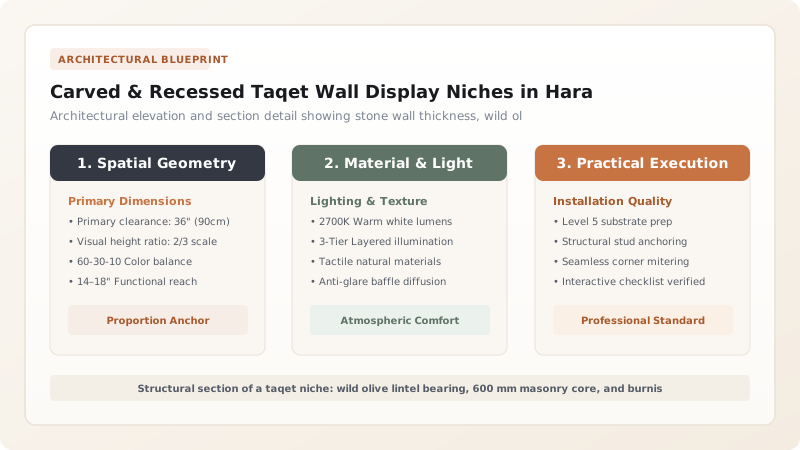
Carving a niche into an active load-bearing wall without compromising structural integrity demands consummate stonecraft. The exterior perimeter walls of the Gidir Gar are laid out with a thickness of 500 to 700 mm. Masons lay double-wythe limestone ashlar blocks along the outer face, while leaving precisely calculated rectangular voids on the interior wythe to form the niches, ensuring at least 250 mm of solid stone core remains behind each alcove.
The head of each niche is spanned by a structural lintel. Because long pieces of straight hardwood were rare in the arid highlands, carpenters utilized split culms of highland African bamboo (Arundinaria alpina) bundled tightly together, or hand-hewn squared bars of wild olive wood (Olea europaea subsp. cuspidata, known as weyra). Weyra is an extraordinarily dense, oily hardwood impervious to termite attack and fungal dry rot. These lintels bear at least 150 mm on either side of the opening, evenly transferring upper masonry loads around the niche void.
The Hierarchy of Prestige: Books, Porcelain & Sacred Geography
The arrangement of objects within the taqet follows a strict sacred and domestic taxonomy. At the highest point of the wall, closest to the timber ceiling beams, sits the Eqrad Taqet (Niche of the Books). Positioned well out of reach of children and casual touch, this alcove is lined with silk cloths to shelter hand-copied Qurans, parchment prayer rolls (kitab), and leather-bound scholarly treatises in Arabic and Harari. Placing holy scriptures at the physical apex of the room honors the Islamic precept that the word of God must always reside higher than all worldly possessions.
Slightly lower, in the central register, lies the Amir Taqet, flanked by the Sini Taqet. Here, the material fruits of Harar's historic maritime commerce are arrayed. Blue-and-white porcelain bowls (sini) imported from Ming and Qing China, celadon plates, and Persian glazed ceramics are propped vertically against the white rear walls. Below them, brass coffee ewers (jebena), hammered copper trays, and silver rosewater sprinklers catch the light, reflecting the cosmopolitan sophistication of this mountain city.
Acoustic Diffusion & Textile Interplay with Harari Basketry
Beyond visual splendor, the taqet wall performs an essential acoustic function. In a room built entirely of hard crystalline limestone and polished earthen platforms, spoken words, laughter, and choral Quranic chanting would naturally generate harsh, reverberant flutter echoes. The deeply recessed taqet niches act as natural acoustic cavity resonators and diffusers, breaking up specular sound reflections.
This acoustic dampening is amplified by the crowning glory of Harari craftsmanship: ceremonial coiled baskets (mot gar). Woven by women from dried wild grasses, palm fronds, and plant fibers dyed in brilliant hues of saffron yellow, indigo, and crimson, these circular baskets are hung from small wooden pegs set directly into the mortar joints between niches. The fibrous, porous texture of dozens of overlapping baskets acts as an acoustic sound-absorption panel, converting the stone hall into a warm, intimate acoustic environment perfectly tuned for whispered conversation and meditative recitation.
Taqet Niche Typologies & Display Protocols
Use this reference table to calculate exact physical dimensions, ratios, and specifications before purchasing:
| Niche Typology | Position on Wall | Typical Dimensions (H x W x D) | Primary Function | Displayed Artifacts |
|---|---|---|---|---|
| Amir Taqet (Ruler's Niche) | Upper center-right | 600 x 400 x 300 mm | Royal honors, diplomatic prestige gifts | Gilded perfume flagons, imperial gifts, fine incense |
| Eqrad Taqet (Scripture Niche) | Upper central zone | 450 x 350 x 250 mm | Sacred preservation of religious texts | Hand-copied leatherbound Qurans, Hadith manuscripts |
| Tit Taqet (Lesser Niche) | Lower flanking tiers | 300 x 250 x 200 mm | Everyday utility and tea service storage | Glass tumblers, tin spice caddies, brass match holders |
| Dera Taqet (Deep Locker) | Floor level / platform corner | 800 x 500 x 450 mm | Secure storage for valuables and bridal wealth | Heavy wooden lockbox, silver coin purses, amber beads |
| Sini Taqet (Porcelain Alcove) | Mid-level horizontal band | 350 x 350 x 250 mm | Display of maritime trade wealth | Chinese blue-and-white porcelain bowls, Persian celadon |
Practical Constraints
Every successful decoration project must account for physical and environmental constraints:
Direct ultraviolet sunlight fading ancestral natural-dyed Harari basketry
Vegetable-dyed grasses (turmeric, indigo, madder) in baskets lose vibrancy over time Mitigation: Orient the Gidir Gar entrance away from the midday solar arc and install deep timber lintel eaves
Acoustic flutter echoes across high, stone-walled living halls
Hard masonry surfaces create excessive reverberation during speech and scriptural recitation Mitigation: Recessed taqet niches filled with porous coiled baskets and textile mats act as natural acoustic diffusers
Execution Blueprint & Craftsmanship Sequence
Execute this professional sequence to achieve flawless results without backtracking:
Masonry Grid Calibration
Establish the vertical centerlines and horizontal coursing lines across the primary wall for symmetrical niche distribution.
Jamb Stone Setting
Lay squared limestone blocks to define the vertical sides (jambs) of each alcove, maintaining plumb vertical lines.
Back-Wall Rubble Courset
Build the continuous back wall of the niche using dense volcanic basalt to maintain structural mass and acoustic buffering.
Wild Olive Lintel Installation
Place hand-hewn wild olive (weyra) timber lintels across the top of each opening, bearing at least 150 mm on flanking masonry.
Architrave Mortar Tooling
Tool the edges of each opening with an elastic hydraulic lime-and-clay mortar to create crisp or softly rounded corners.
Gypsum & Lime Putty Plastering
Apply a two-coat plaster of fine slaked lime and white volcanic gypsum (nora) across the entire niche interior.
Agate Stone Burnishing
Buff the damp plaster using smooth river agate stones to compact the surface into a mirror-smooth reflective finish.
Display Arrangement & Curation
Carefully mount illuminated Qurans on the top tiers and place antique Chinese porcelain bowls on lower display shelves.
Common Mistakes & Countermeasures
Avoid these costly errors that compromise aesthetics, ergonomics, and budget:
Recessing niches too deeply into thin exterior perimeter walls
Using green, unseasoned eucalyptus wood for internal niche lintel beams
Painting niche interiors with modern synthetic glossy oil paints
Project Execution Checklist
Track your physical progress. Checkboxes persist automatically on this device:
Frequently Asked Questions
How did Chinese porcelain end up in Harari wall niches in eastern Ethiopia?
Harar was a major terminal node of Indian Ocean maritime trade routes connecting Cairo, Yemen, and the Persian Gulf with the East African ports of Zeila and Berbera. For centuries, Arab and Somali merchants traded coffee, ivory, and frankincense for high-fired blue-and-white Chinese porcelain bowls (Ming and Qing dynasties), which became the ultimate symbols of Harari domestic refinement.
Why are the niches painted pure white instead of colorful patterns?
The brilliant white lime-and-gypsum plaster (nora) provides maximum optical contrast against the deep red burnished floors and the kaleidoscopic reds, greens, and purples of hand-woven Harari coiled baskets (mot gar). The luminous white backdrop reflects soft daylight deep into the otherwise windowless stone hall.
Do taqet niches have doors or shutters?
Most ceremonial taqet are entirely open without wooden shutters, celebrating open hospitality and honest domestic display. Only the deep storage lockers (Dera Taqet) or rare medicine niches possess carved wooden doors secured with traditional iron sliding bolts.