
Freehand Modeled Haut-Relief Heraldic Beasts represents the crowning glory of English Jacobean decorative plasterwork. Unlike repetitive molded stucco work, authentic East Anglian high-relief pargeting is sculpted directly onto the building facade entirely by hand. Master plasterers build internal armatures from hand-forged iron spikes, copper wire, and hazel laths fastened to structural timber studs. Successive layers of stiff, fibrous lime-hair mortar are built up and carved in situ with modeling spatulas and fingers, creating dramatic three-dimensional lions, unicorns, dragons, and royal coats of arms that project up to 150mm from the wall plane.
At a Glance: Key Takeaways
- Direct Facade Sculpture: Modeling monumental high-relief figures in situ without pre-cast molds or workshops.
- Forged Iron & Hazel Armatures: Anchoring deep projections with iron spikes and flexible hazel branch armatures.
- Lead & Copper Wire Skeletons: Wrapping pliable wire around armatures to provide tooth and mechanical grip for wet plaster.
- High-Hair Mortar Formulation: Incorporating up to 20% long ox hair by volume to hold heavy wet plaster shapes in mid-air.
- Royal & Mythological Iconography: Sculpting Tudor roses, royal coats of arms, lions rampant, unicorns, and green men.
- Monolithic Facade Integration: Seamlessly tying sculpture directly into the surrounding exterior weatherproofing render.
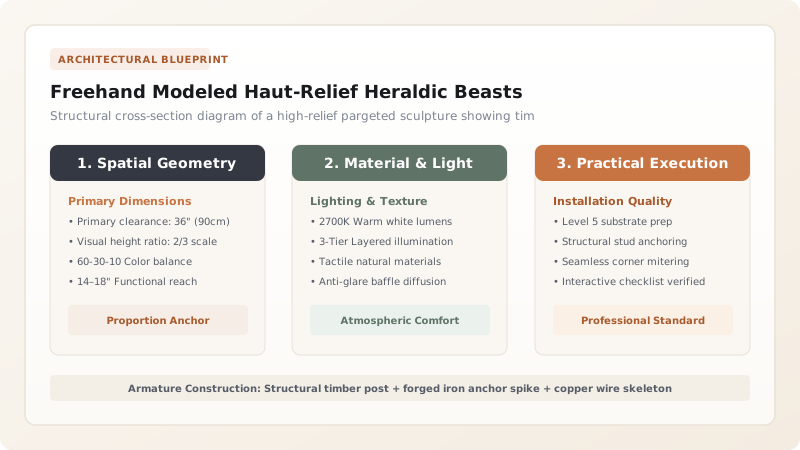
1. Cultural Context: The Jacobean Renaissance of the Facade
Following the restoration of the English monarchy in 1660, wealthy cloth merchants and landowners in Essex and Suffolk sought to display their loyalty and prosperity through monumental heraldic facades. The crowning masterpiece of this era is the Ancient House in Ipswich (1670), where entire allegorical continents, royal coats of arms, and mythical beasts billow across the exterior gables.
Rather than ordering imported Italian stuccoists, these works were executed by local English guild plasterers. The aesthetic was a joyful fusion of sophisticated court Renaissance engravings and uninhibited English folk vitality, where lions grin roguishly and Tudor roses burst with three-dimensional vitality.
2. Structural Armatures: Spikes, Wire, and Hazel Twigs
A solid mass of wet lime plaster 100mm thick would collapse under its own weight and slide off the wall long before it could carbonate. High-relief pargeting requires an engineered internal structural skeleton:
- Forged Iron Spikes: Heavy square-shank iron nails or threaded rods are driven 75mm into the underlying structural oak timber studs at key load points (e.g., a lion's head or torso).
- Hazel & Willow Wattle: Naturally curved branches of green hazel or coppiced willow are bent into shape and lashed to the spikes to create volumetric ribs.
- Wire Skeleton Wrapping: Pliable copper, brass, or lead wire is wrapped in tight spirals around the wooden ribs, creating continuous mechanical teeth that catch and support the wet hair-mortar.
3. Sculptural Execution: Building Up the Hair-Lime Core
Modeling proceeds in three deliberate geological stages over several weeks:
- Rough Core Coat (The Muscle): A very stiff, dry mortar composed of 1 part fat lime putty, 1.5 parts sharp coarse sand, and a tremendous concentration of long ox-hair (up to 20% by volume). This fibrous dough is pressed firmly around the wire armature, forming the basic anatomy, and left to firm for 7 days.
- Modeling Intermediate Coat (The Form): A medium-grit mortar is applied over the keyed core, sculpting muscle groups, drapery folds, and facial contours with steel spatulas and boxwood modeling tools.
- Fine Skin Coat (The Detail): A fine, hair-free lime-marble dust slip is applied paper-thin to carve delicate claws, lion mane ringlets, and heraldic mottoes.
Haut-Relief Pargeting Armature & Mortar Build-Up
Use this reference table to calculate exact physical dimensions, ratios, and specifications before purchasing:
| Build-Up Stage | Internal Armature Material | Mortar Binder-to-Aggregate | Hair / Fiber Dosage | Maximum Projection (mm) |
|---|---|---|---|---|
| Structural Skeleton | Forged iron spikes (150mm) + copper wire | None (mechanical armature) | Direct mechanical anchor | Projects 100mm from wall |
| Rough Core Body | Bent hazel twigs lashed to wire | 1 part Lime Putty : 1.5 parts Sand | Dense ox-hair (20% vol) | 50mm build-up layer |
| Anatomical Modeling | Encapsulates core armature | 1 part Lime Putty : 2.0 parts Graded Sand | Fine goat hair (5% vol) | 25mm sculpting layer |
| Detail Skin Finish | Direct application over leather-hard body | 1 part Slaked Lime : 1.5 parts Marble Dust | Zero fiber (pure paste) | 3mm fine detail layer |
Artistic & Weather Constraints
Every successful decoration project must account for physical and environmental constraints:
Severe Weather Exposure
Exterior relief sculptures project into the path of driving rain and wind-scour, requiring continuous maintenance with seasonal limewashes.
Rare Sculptural Specialization
Modeling anatomical figures freehand on a scaffold requires high artistic mastery combined with deep masonry chemistry knowledge.
Protocol for Modeling an Exterior Haut-Relief Heraldic Beast
Execute this professional sequence to achieve flawless results without backtracking:
Timber Stud Locating & Spiking
Locate structural oak studs behind lath; drive 150mm forged stainless steel or copper spikes into timber at animal torso, head, and limb points.
Hazel Rib & Wire Skeleton Assembly
Lash bent hazel twigs across spikes using annealed copper wire; wrap skeleton in tight wire spirals to create continuous mortar key.
Heavy-Hair Core Dough Packing
Mix stiff lime-sand mortar heavily loaded with ox hair; press firmly into wire skeleton; build up anatomical core; key surface with cross-hatch cuts.
Carbonation Pause (7 Days)
Allow the core to firm up under damp hessian for one week until solid enough to bear fingertip pressure without deforming.
Fine Anatomical Sculpting
Apply intermediate modeling coat; carve facial expressions, lion manes, and heraldic shields using steel modeling spatulas and fingers.
Skin Detailing & Limewash Capping
Refine eye pupils, claws, and fur textures with fine tools; allow 6 weeks carbonation before coating with 5 coats of tallow limewash.
Common Mistakes & Countermeasures
Avoid these costly errors that compromise aesthetics, ergonomics, and budget:
Using ungalvanized mild steel wire or iron nails without rust protection
Applying thick sculptural layers all in a single day without waiting for curing
Project Execution Checklist
Track your physical progress. Checkboxes persist automatically on this device:
Frequently Asked Questions
How do sculpted lime plaster figures survive 350 years of British rain?
The longevity of pargeting lies in the chemistry of carbonation. Over decades, calcium hydroxide (slaked lime) absorbs atmospheric CO2, converting into crystalline calcium carbonate—the exact mineral of limestone and marble. The sculpture literally petrifies into a solid block of artificial stone, bound internally by the dense network of animal hair fibers and protected by annual sacrificial coats of limewash.
Can high-relief pargeting be repaired if parts break off?
Yes. A conservator drills small holes into the remaining sound core, inserts new stainless steel dowels, and wraps them in fine wire. Fresh lime-hair mortar matching the original historic aggregate ratio is applied in layers, sculpted to match the archival photographs of the original heraldic beast, and blended seamlessly into the surrounding historic surface.


