
Layout and carve authentic linenfold panels by establishing a symmetrical cross-section of alternating convex ribs and concave ogee troughs across a 3/4-inch quartersawn oak panel. Plane the continuous vertical folds using specialized hollow and round molding planes, and hand-carve the top and bottom parchment scroll ribbon terminations with #7 bent gouges.
At a Glance: Key Takeaways
- Alternating Symmetrical Ogee Cross-Section: S-shaped flowing curves simulate the natural draping of woven fabric.
- Hollow & Round Molding Planes: Historic wood planes mill continuous vertical flute profiles with speed and precision.
- Parchment Scroll Ribbon Terminations: Delicate undercut rolls at the top and bottom edges represent rolled manuscript scrolls.
- Compound Gouge Work: #5 sweep gouges shape broad folds; #7 bent gouges undercut rolled scroll terminations.
- Preservation of Hand-Chiseled Facets: Microscopic tool marks catch ambient light, distinguishing handmade work from plastic CNC.
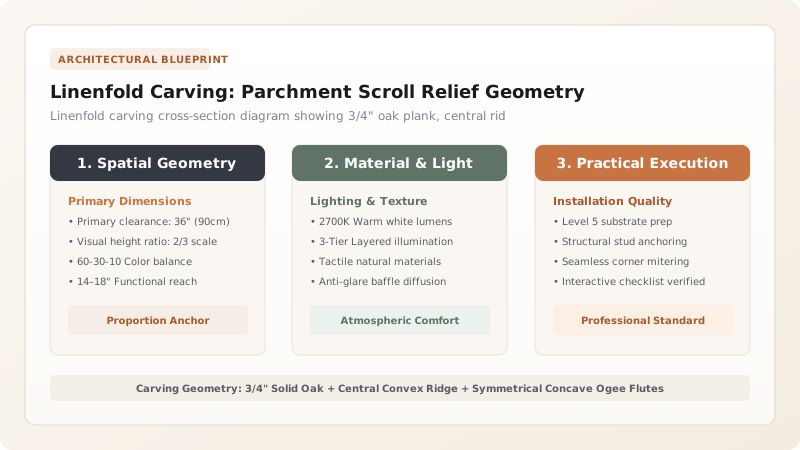
1. Trigonometric Profiling: The Alternating S-Curve Drapery Grid
The cross-section of a linenfold panel is governed by strict Symmetrical Geometric Radii. Dividing a 14-inch wide oak panel into four equal bays establishes the apex points for Alternating Convex Ribs and Concave Ogee Valleys.
The carver uses Wooden Hollow and Round Molding Planes (or specialized linenfold scratch stocks) to plane the continuous vertical grooves down the entire panel length to a uniform 3/8-inch (10mm) depth. Learn about frame joinery in quartersawn oak stiles and rails.

2. Parchment End Carving: Undercutting Scrolled Foliations
While the center vertical folds are straight, the top and bottom 2 inches of the panel transition into Compound 3D Scrolled Parchment Terminations.
Using a #7 Bent Gouge and V-Parting Chisel, the carver sculpts three-dimensional rolled ribbons that appear to curl out of the wood face. Hand-scraping leaves soft tool facets that enrich ammonia fuming patinas.
Linenfold Carving Tools & Profile Specifications
Use this reference table to calculate exact physical dimensions, ratios, and specifications before purchasing:
| Carving Step | Specialized Woodworking Tool | Cut Geometry & Depth | Aesthetic Function |
|---|---|---|---|
| Vertical Flute Roughing | Wooden Round Plane / Core Box Router | 3/8" (10mm) Concave radius | Establishes linear vertical fold grid |
| Convex Ridge Shaping | Hollow Plane / Block Plane | 1/2" Convex S-curve ogee | Forms raised central drapery crests |
| Parchment Scroll Undercutting | #7 Sweep Bent Carving Gouge | 1/4" (6mm) Undercut hollow | Creates 3D curled fabric roll effect |
| V-Groove Shadow Detailing | 60° V-Parting Chisel | 1/8" Sharp shadow lines | Accentuates folded ribbon crease borders |
Grain Tearout End-Grain Carving Constraints
Every successful decoration project must account for physical and environmental constraints:
Carving Against the Oak Grain Causing Massive Splintering on Scrolled Ends
English oak is tough with dense grain; carving into end-grain can tear out large chunks; always hone carving gouges to a razor 20-degree bevel on Arkansas oil stones, slicing diagonally with skewed push cuts across the wood grain.
How to Layout and Carve a Linenfold Panel
Execute this professional sequence to achieve flawless results without backtracking:
Dimension 3/4" Quartersawn Oak Panel
Plane panel flat, square, and true to 14" width × 22" height × 3/4" thickness.
Scribe Vertical Centerlines and Ogee Grid
Draw grid with marking gauge defining central ridge, two lateral folds, and outer field margins.
Plane Linear Vertical Flutes
Run hollow and round planes from end to end to hog out the parallel concave vertical flutes.
Shape Raised Ogee Ridge Crests
Blend ridges with small curved spokeshave until the drapery rolls in smooth S-curves.
Carve Scrolled Parchment Ribbon Ends
Layout curled scroll pattern on top and bottom; carve undercut volutes using #7 bent gouges.
Cut 1/4" Perimeter Tongue on Shaper
Rout 1/4" tongue around all 4 edges to fit into stile/rail frame grooves.
Hand-Scrape Surface with Card Scraper
Clean up tool marks with curved French card scrapers (do NOT oversand with sandpaper).
Common Mistakes & Countermeasures
Avoid these costly errors that compromise aesthetics, ergonomics, and budget:
Oversanding Carved Linenfold Panels with Rotary Orbital Sanders
Project Execution Checklist
Track your physical progress. Checkboxes persist automatically on this device:
Frequently Asked Questions
Can linenfold panels be rough-machined on a 3-axis CNC router?
Yes! Modern high-end millwork shops rough-cut the bulk 3D linenfold geometry on a 3-axis CNC router using ball-nose bits, then have master woodcarvers hand-chisel the final scroll undercuts and tool facets.


