Vermilion-lacquered double timber doors and cast brass lion knockers (Poushou) are the iconic visual and tactile threshold elements of the Beijing Siheyuan. Handcrafted from heavy Scots pine or camphorwood slabs, the doors are reinforced with hemp cloth and coated in multi-layered natural cinnabar mineral lacquer. Heavy cast brass or bronze lion-head knockers with swinging pull rings ward off negative energy while providing secure door locking.
At a Glance: Key Takeaways
- Timber Substrate: Kiln-seasoned Scots pine (Zhangzisong), Nanmu, or Camphorwood slabs
- Lacquer Specification: Natural Urushi tree sap infused with pure cinnabar mineral pigment (Zhuhong / 朱红)
- Lamination Matrix: Coarse hemp fabric (Xiabu) adhered with bone glue and pig-blood gesso sizing
- Door Hardware: Cast brass or bronze beast-face door knockers (Poushou / 铺首) with pull rings
- Symbolic Role: Repels negative spiritual ingress; signifies family prestige and vital yang energy
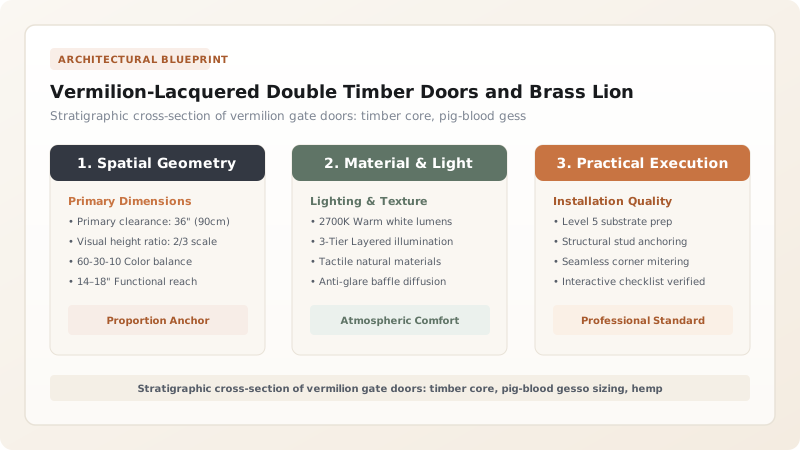
The Color of Imperial Sovereignty: Cinnabar Vermilion (Zhuhong)
Few sensory experiences define the historic hutongs of Beijing as vividly as the sight of a massive pair of vermilion-lacquered double doors (*Zhuhong Damen*) framed by grey brickwork and sheltered beneath grey tile eaves. In traditional Chinese color symbolism, red is not merely an aesthetic choice; it is the physical manifestation of Yang energy—the cosmic force of the sun, life, vitality, and imperial sovereignty.
Authentic vermilion (*Zhuhong*) was not created using modern synthetic coal-tar dyes or chemical pigments. It was derived from pure natural cinnabar (mercuric sulfide, HgS), an unalterable mineral mined from ancient subterranean veins in Hunan and Guizhou. When pulverized into talc-like powder and bound within natural tree lacquer, cinnabar produced a dense, vibrating crimson that possessed extraordinary optical opacity and an impervious resistance to fading under intense high-altitude sunlight.
The Armor Beneath the Gloss: Hemp Lamination and Pig-Blood Gesso
The extraordinary durability of Chinese courtyard gates—many of which have survived centuries of freezing dust storms, blazing heatwaves, and seasonal monsoons—is attributable to a sophisticated multi-layered composite engineering technique known in guild records as Dimo (地魔, the foundation underlayment).
Solid timber doors expand and contract continuously across seasons. If lacquer were applied directly to raw wood, joint expansion would crack the glass-like finish within months. To prevent this, carpenters laminated the entire wooden core with Xiabu—coarse, open-weave raw hemp cloth. The cloth was embedded within a traditional gesso putty compounded from fresh pig’s blood (*zhuxue*), warm bone glue, and microscopic brick dust. The natural proteins in the animal serum cross-linked with the mineral silicates to form an elastic, indestructible sheath that bridges timber seams, completely isolating the exterior lacquer coats from wood movement.
Urushi Chemistry: The Polymerization of Raw Tree Lacquer
Over the hemp foundation, the master applied multiple coats of natural raw lacquer (*Daqi*), harvested from incisions in the bark of the Toxicodendron vernicifluum tree. Unlike Western paints that dry via the simple evaporation of petroleum thinners or water, natural Chinese lacquer cures through a remarkable enzymatic oxidation process.
The active constituent, urushiol, reacts with atmospheric oxygen only in the presence of natural laccase enzymes, which require an ambient relative humidity of 70% to 80% and a temperature of 20°C to 25°C to polymerize. To achieve this, newly lacquered doors were placed into dark, humidified curing chambers known as Yushi (lacquer caves). Over several weeks, the liquid sap transformed into an insoluble, three-dimensionally cross-linked polymer that is completely impervious to water, boiling alcohol, household acids, and subterranean termites.
Poushou: The Bronze Dragon-Son Guardians of the Threshold
Mounted at eye level upon each vermilion door leaf is the sculptural crown of the threshold: the Poushou (铺首, beast-face door knocker). Cast in solid brass or bronze using the ancient lost-wax method, the poushou typically depicts the fierce, scowling face of Jiaotu (椒图), the ninth mythical son of the Dragon King.
In Chinese mythology, Jiaotu was renowned for his hatred of intruders and his fierce defensive nature; he kept his shell closed tight like a clam. Mounted upon domestic gates, his ferocious scowl, flaring nostrils, and sharp fangs held an apotropaic power that warded off wandering demons and malicious energy. Clamped firmly within the beast’s jaws is a heavy, solid bronze ring. When swung against the thick, resonance-dampened timber door, the ring produces a deep, metallic chime that reverberated through the courtyard, announcing the arrival of guests with dignity, safety, and imperial elegance.
Door Timbers, Lacquer Formulations & Beast Knocker Classifications
Use this reference table to calculate exact physical dimensions, ratios, and specifications before purchasing:
| Door Element | Material Formulation | Application Tool / Method | Functional & Symbolic Role | Imperial Code Association |
|---|---|---|---|---|
| Timber Core Planks | Old-growth Scots pine (Zhangzisong) | Heavy 60–80 mm splined planks | Structural door leaf core; thermal insulation | Universal across all residential gates |
| Hemp Sizing (Dimo) | Raw hemp fabric + pig blood gesso | Wide hog-hair paste wash brushes | Prevents wood grain cracking; structural reinforcement | Foundational underlayment on all doors |
| Vermilion Lacquer (Zhuhong) | Urushi lacquer + pure cinnabar (HgS) | Human-hair lacquer brushes (Maozhu) | Vibrant solar red; impervious to water & acid | Imperial nobility, princes, and high officials |
| Black Lacquer (Heiqi) | Urushi lacquer + pine soot / iron oxide | Polished with charcoal & rottenstone | Solemn dignity; high water resistance | Common gentry and merchant residences |
| Lion Knocker (Poushou) | Lost-wax cast brass or bronze | Through-bolted split-pin fastening | Apotropaic demon warding; functional pull ring | Universal Beijing hutong entrance emblem |
Practical Constraints
Every successful decoration project must account for physical and environmental constraints:
High Toxicity and Contact Dermatitis Risk of Raw Urushi Lacquer Sap
Active urushiol compounds in raw tree lacquer cause severe, painful allergic skin blistering. Mitigation: Master lacquerers wear protective nitrile gauntlets and work in dedicated ventilated lacquer booths.
Strict Humidity Requirement for Natural Urushi Lacquer Curing
Unlike synthetic paints that require dry heat, natural urushi only polymerizes in 75%+ relative humidity. Mitigation: Cure lacquered door leaves inside specialized humidified wooden drying cupboards (Yushi) at 22°C.
Execution Blueprint & Craftsmanship Sequence
Execute this professional sequence to achieve flawless results without backtracking:
Timber Selection and Splined Plank Joinery
Edge-join seasoned 75 mm Scots pine planks using blind hardwood splines, cutting integrated round axle pivot pins into top and bottom outer stile corners.
Gouging Retention Grooves and Sizing
Gouge shallow diagonal mechanical scoring grooves across the wood face, brushing with warm rabbit-skin or bone glue size.
Laminating the Hemp Cloth Skin (Pibu)
Drench coarse raw hemp fabric in a paste of pig blood, bone glue, and pulverized brick ash, stretching it taut over door faces to eliminate bubbles.
Applying the Bone-Ash Lacquer Putty Ground
Trowel three successive coats of lacquer putty (refined clay, bone ash, and raw urushi) over the hemp skin, wet-sanding each coat dead-flat.
Compounding Mineral Cinnabar Vermilion Lacquer
Hand-mull pure pulverized mineral cinnabar (mercuric sulfide) into clear, aged raw urushi lacquer sap, achieving an intense, incandescent crimson.
Brushing and Humid Curing of Lacquer Layers
Brush four micro-thin coats of vermilion lacquer using specialized flat human-hair brushes, curing each coat in a 75% humidity dark drying box for 48 hours.
Mounting the Cast Brass Lion Knockers (Poushou)
Bore matching holes through the door leaves at eye level, insert the threaded brass posts of the lion knockers, and lock from behind with split-key cotter pins.
Common Mistakes & Countermeasures
Avoid these costly errors that compromise aesthetics, ergonomics, and budget:
Applying modern chemical alkyd or oil paints instead of traditional natural lacquer
Omitting the hemp cloth underlayment (xiabu) before applying the lacquer ground
Installing door knockers too low on the door leaves
Project Execution Checklist
Track your physical progress. Checkboxes persist automatically on this device:
Frequently Asked Questions
Why is the mineral pigment cinnabar (vermilion) so revered in Chinese lacquerwork?
Cinnabar (mercuric sulfide, HgS) is an unalterable natural mineral mined since antiquity in Hunan and Guizhou provinces. In Taoist alchemy, cinnabar was the supreme essence of Yang energy, representing immortality, solar fire, and imperial power. When suspended in natural urushi lacquer, its intense crimson hue never fades under sunlight, providing centuries of brilliant color.
What mythological creature is depicted on traditional Chinese door knockers?
Traditional Chinese door knockers depict Jiaotu (椒图), one of the nine legendary sons of the Dragon King. In Chinese mythology, Jiaotu was fiercely protective, naturally secretive, and disliked being disturbed; he kept his shell tightly closed like a clam. Because of this, his likeness was mounted on gates to ensure that doors remained securely shut against malevolent spirits and thieves.
Why was pig blood historically mixed into the lacquer underlayment on Chinese gates?
Traditional Chinese master lacquerers mixed fresh pig blood with bone glue and fine brick ash to formulate "Zhuxuegao" (pig blood putty). The natural serum albumin proteins in the blood cross-linked with the glue and calcium in the brick dust, creating an extraordinarily flexible, water-resistant, crack-proof gesso base that absorbed wood expansion without cracking.