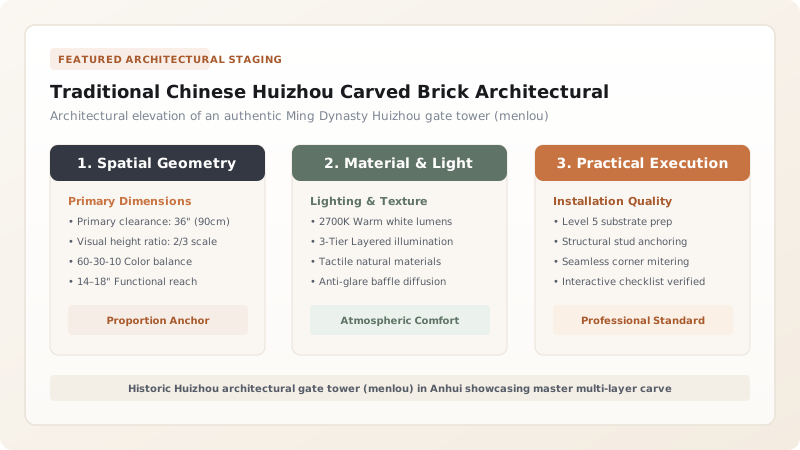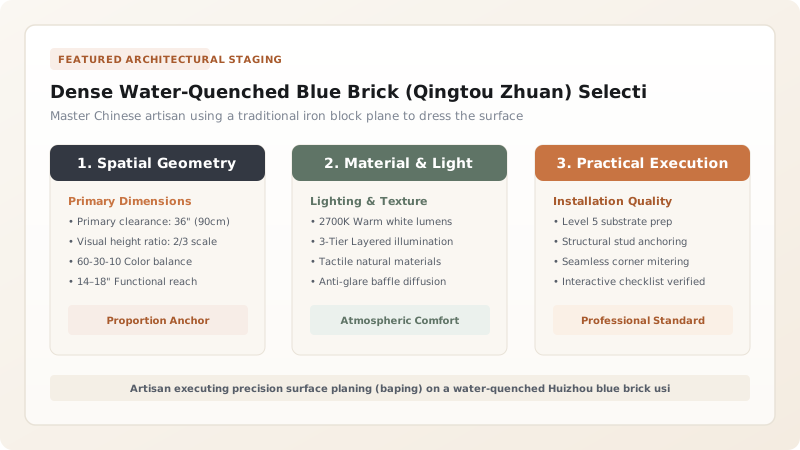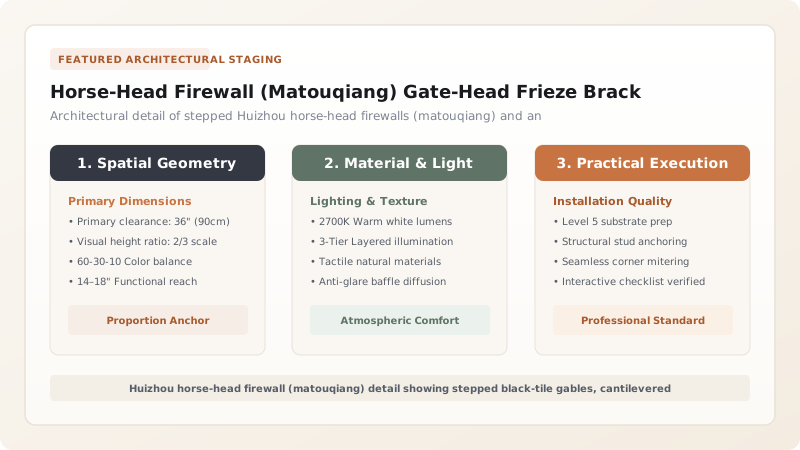
Multi-layer undercutting and deep openwork (Tou Diao) represent the zenith of Huizhou brick carving technique. In a solid blue brick panel only 8 to 10 centimeters deep, master artisans chisel up to five to seven distinct spatial registers, carving foreground human figures, architectural balustrades, and pine boughs completely in the round. By utilizing an arsenal of specialized chisels—including wide flat bolsters, skew chisels (qiaotou dao), curved hollow gouges (yuan dao), and micro-wire saws—the carver hollows out negative space behind foreground elements while maintaining concealed structural stone bridges that anchor the delicate filigree against wind vibration.
At a Glance: Key Takeaways
- Carving Modality: Multi-tier openwork (Tou Diao) & high relief in the round (Yuan Diao)
- Spatial Depth Range: 5 to 7 discrete spatial planes within an 80–100 mm brick depth
- Artisan Toolset: Over 30 specialized chisels: flat bolsters, skew blades, hollow gouges, & wire saws
- Structural Support: Concealed ceramic bridges (shi liang) preserving structural connection to back wall
- Finishing Media: Equisetum horsetail reed abrasive sanding & fine water-sponge honing
The Hierarchy of Carving Modalities in Huizhou
In the technical canon of Huizhou brick carving, craftsmanship is categorized into four distinct sculptural modalities that are combined synergistically within a single architectural composition: Qian Diao (shallow incised line carving), Fu Diao (bas-relief modeling), Tou Diao (pierced openwork undercutting), and Yuan Diao (sculpture completely in the round).
While common regional masonry relied solely on shallow surface chiseling, the masters of Huizhou achieved world renown by pushing the physical limits of Tou Diao. In an ordinary brick measuring merely 8 to 10 centimeters in depth, the carver executes five to seven distinct horizontal and vertical registers of relief, allowing the eye to penetrate deep past foreground pavilions into receding courtyards and misty mountain horizons.
The Master Carver's Toolset and Kinetic Control
Executing multi-layered openwork requires an astonishing array of specialized hand tools, custom-forged by village blacksmiths from high-carbon tool steel. A master carver's chest contains upwards of forty chisels: wide flat bolsters (da ping dao) for mass stock removal; micro-skew chisels (qiaotou dao) with 30-degree and 60-degree angled cutting lips for reaching into cramped corner crevices; semicircular gouges (yuan dao) ranging from 2 mm to 30 mm in curvature; and hook-shaped spoon chisels designed to reach completely behind a sculptured figure to hollow out its reverse side.
Unlike stonecarvers who swing heavy iron mallets, the Huizhou brick carver operates with delicate, rapid taps of a lightweight horn or boxwood mallet (mupa). The brick is supported upon a heavy leather sandbag filled with fine river sand. The sand acts as a universal fluid damper, absorbing kinetic shockwaves that would otherwise reverberate through the brittle ceramic body and snap off delicate cantilevered branches or human arms.
Engineering the Negative Space: The Concealed Ceramic Bridge
The supreme technical paradox of Huizhou openwork is how an unreinforced, brittle ceramic material can support sprawling filigree—such as flying phoenix tails, dangling lantern tassels, and galloping horse hooves—without collapsing under gravity or wind vibration. The secret lies in the art of shi liang (concealed ceramic bridges).
A master carver never severs foreground elements completely from the background wall. As the artisan hollows out the void behind a scholar figure, they preserve slender, tapered ceramic webs connecting the back of the figure's torso, knees, or staff to structural columns in the middle ground. These bridges are tapered inward and sculpted at precise optical angles so that to a viewer looking upward from the courtyard below, the bridges are completely invisible, creating the miraculous illusion that the carved figures are floating freely in space.
Micro-Detailing and the Horsetail Reed Polish
Once the spatial registers and openwork cavities have been fully cleared, the carving enters its final phase: micro-surface detailing. Using needle-fine chisels (qizhen), the master engraves individual hair strands on scholar beards, the microscopic tile patterns on distant temple roofs, the delicate veins of lotus leaves, and the brocade patterns on silk robes.
To finish the relief, the artisan eschews modern abrasive papers, which would leave coarse scratching and dull the crisp arrises. Instead, the carving is polished using muzei (dried scouring horsetail reeds, Equisetum hyemale) dipped in clean water. The natural microscopic silica crystals embedded in the plant fibers polish the blue brick to a soft, tactile, satin-matte luster that catches natural daylight with the luminous glow of ancient jade.
Hierarchical Carving Techniques in Huizhou Architectural Reliefs
Use this reference table to calculate exact physical dimensions, ratios, and specifications before purchasing:
| Technique Name | Relief Character | Chisel Depth | Visual Function | Architectural Placement |
|---|---|---|---|---|
| Qian Diao (Shallow Relief) | Flat, incised linework (<3 mm) | 1 mm to 3 mm | Text inscriptions, brocade patterns, distant clouds | Background panels & border trim |
| Fu Diao (High Relief) | Projecting rounded volumes (10–30 mm) | 10 mm to 35 mm | Secondary courtyard architecture, horses, trees | Mid-ground registers |
| Tou Diao (Openwork / Piercing) | Completely detached airborne filigree | 40 mm to 80 mm | Foreground scholar figures, bridges, flying dragons | Primary focal centers of gate friezes |
| Yuan Diao (Full Round Sculpting) | Fully freestanding 3D statues | Full block thickness | Eave bracket support lions and guardian figures | Cantilevered gatehead brackets |
Practical Constraints
Every successful decoration project must account for physical and environmental constraints:
High Risk of Irreversible Tool Slips During Final 1 mm Filigree Detailing
A single snapped chisel blade can decapitate a miniature scholar figure after 80 hours of work. Mitigation: Stabilize the carver's hands with sandbag armrests and apply temporary paraffin wax beds behind fragile filigree.
Thermal Shock and Frost Cracking in Deeply Undercut Crevices
Moisture collecting in narrow 2 mm undercuts expands during winter freezes, popping openwork features. Mitigation: Design subtle downward drainage slopes into all interior horizontal undercut shelves to prevent water pooling.
Execution Blueprint & Craftsmanship Sequence
Execute this professional sequence to achieve flawless results without backtracking:
Depth Register Mapping and Cartoon Stratigraphy
Color-code the master cartoon into four depth registers: background sky/mountains (0–15 mm), architectural pavilions (15–40 mm), secondary figures/flora (40–65 mm), and foreground action (65–90 mm).
Workbench Rigging and Sandbag Cushioning
Place the planed blue brick upon a heavy leather sandbag on an oak workbench. The sand absorbs vibration and allows the brick to be tilted dynamically to optimal carving angles.
Blocking Out and Mass Trenching (Da Pi)
Drive flat bolsters (ping dao) along the perimeter contours of the foreground silhouettes, trenching away waste material to establish the primary depth steps without chipping detail edges.
Rough Anatomical and Structural Shaping (Xiao Pi)
Using medium curved gouges (yuan dao), rough-shape the curved volumes of human torsos, horse flanks, temple columns, and curving tile eaves, creating distinct three-dimensional forms.
Initiating Deep Undercutting (Tou Diao)
Angle specialized skew chisels (qiaotou dao) at 45 degrees behind the foreground figures, slicing away the rear ceramic matrix to separate limbs, robes, and balustrades from the background wall.
Negative Space Piercing with Abrasive Wire Saws
Drill micro-starter holes through negative space pockets with hand drills, thread fine diamond abrasive wire saws, and saw away interior voids behind hollow window screens and chair legs.
Carving Concealed Anchor Bridges (Shi Liang)
As undercutting progresses, leave hidden 5 mm ceramic ribs connecting the back of figures to background columns, ensuring structural stability without compromising the optical illusion of free float.
Micro-Sculptural Detailing and Reed Honing
Engrave eyes, fingernails, robe brocades, and pine needles with fine needle chisels (qizhen). Rub the finished surfaces with water and dried horsetail reeds (Equisetum) to remove chisel scratches, revealing a satin finish.
Common Mistakes & Countermeasures
Avoid these costly errors that compromise aesthetics, ergonomics, and budget:
Removing all ceramic material behind foreground figures, severing structural anchor bridges
Striking chisels with heavy steel hammers rather than lightweight wooden or horn mallets
Carving deep undercuts before establishing broad spatial depth registers across the entire panel
Project Execution Checklist
Track your physical progress. Checkboxes persist automatically on this device:
Frequently Asked Questions
How many tools does a traditional Huizhou brick carver use?
A master Huizhou carver maintains an arsenal of thirty to fifty specialized hand-forged steel chisels. These include flat bolsters (ping dao) of various widths for surface trenching, skew chisels (qiaotou dao) for tight angled undercutting, semicircular gouges (yuan dao) for rounded botanical folds, curved spoon chisels for reaching behind hollowed figures, and micro-punches (qizhen) for hair and textile texture.
What prevents deeply undercut figures from snapping off?
The secret lies in the strategic retention of 'shi liang' (concealed stone bridges). Master carvers never completely sever foreground elements from the rear brick wall. Instead, they leave hidden, tapered bridges of solid ceramic behind heads, shoulders, and tree trunks, positioned at sightlines invisible to a viewer standing on the street below.
Why is the brick placed on a sandbag during carving?
Blue brick is hard, dense, and brittle. Placing it directly on a rigid wooden or stone workbench would cause hammer blows to bounce and reflect destructive shockwaves back through the brick, causing delicate cantilevered filigree to snap off. A leather sandbag absorbs and dissipates kinetic shock while allowing the mason to tilt the brick freely at any angle.
How long did it take an ancient master to carve a single gatehead frieze?
A complex multi-brick gatehead frieze (menlou)—typically consisting of 12 to 24 interlocking blue bricks depicting historical narratives with dozens of figures—demanded between six and eighteen months of continuous, full-time labor by a master carver and two apprentices.