Cantilevered ironwood timber drum pavilions represent the dynamic intermediate level (madya) of the traditional Balinese Bale Kulkul. Raised high above the stone plinth, the open-air pavilion is framed using rot-immune Borneo ironwood (kayu ulin) or mature teak (kayu jati). Master carpenters (Undagi) assemble four or six monolithic posts linked by cantilevered crossbeams (sunduk) using traditional mortise-and-tenon joints pegged with cured bamboo dowels. Consecrated with sacred calligraphic talisman cloths (ulap-ulap), the flexible timber frame houses the heavy slit drums while absorbing seismic shocks.
At a Glance: Key Takeaways
- Timber Species: Borneo Ironwood (Kayu Ulin / Eusideroxylon zwageri) & Teak (Jati)
- Carpentry System: Mortise-and-tenon (siku pegat) pegged with bamboo dowels (pasak)
- Structural Support: Free-resting on andesite stone umpak pedestals (non-anchored)
- Sacred Talisman: Kain Ulap-Ulap (inscribed white cotton cloth mounted at ridge)
- Structural Behavior: Flexible moment frame with non-linear seismic damping
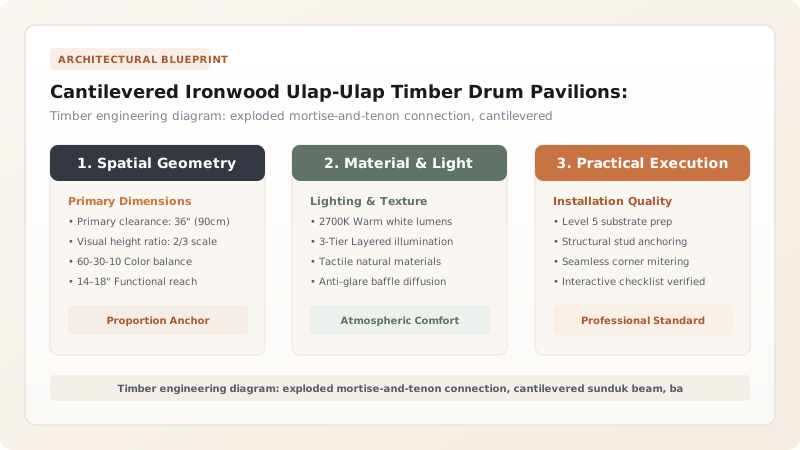
The Intermediate Realm: Madya and Timber Mechanics
In the cosmological zoning of the Balinese Bale Kulkul, the intermediate level—the madya—represents the human sphere. Elevated six to fifteen feet above the ground upon the massive stone plinth, this level takes the form of an airy, open-sided timber pavilion. Here, human watchmen stood guard, and here the sacred acoustic voices of the community—the kulkul slit drums—were suspended.
Because this pavilion is perched at the top of a stone plinth, it is subjected to intense environmental forces. Gale-force monsoon squalls create immense lateral wind shear, while the violent swinging and pounding of heavy wooden slit drums generates continuous cyclic dynamic loads. To withstand these forces without relying on modern steel frames or bracing struts, Balinese master carpenters developed a sophisticated post-and-beam structural system that balances extreme timber density with flexible mechanical joinery.
Material Immortality: Borneo Ironwood (Kayu Ulin)
The supreme timber specified for Bale Kulkul construction is Borneo ironwood, known throughout the Indonesian archipelago as kayu ulin or belian (Eusideroxylon zwageri). Native to the primary rainforests of Kalimantan and Sumatra, ulin was transported across the Java Sea to Bali by seafaring Bugis and Balinese merchant fleets. Ulin possesses physical properties that border on the miraculous: it has an extraordinary air-dry density exceeding 1,000 to 1,200 kg/m³, causing it to sink instantly in freshwater.
More importantly, ulin is naturally impregnated with dense silica crystals and toxic biochemical resins that render it completely impervious to biological degradation. Termites and wood-boring beetles cannot penetrate its stone-hard fibers, while wood-decaying fungi cannot survive within its heartwood. When exposed to tropical rain and scorching equatorial sun, ironwood does not rot or split; instead, it weathers gracefully from golden brown to an elegant, silvery charcoal patina, maintaining its structural compressive strength across centuries.
The Tectonic Discipline of Siku Pegat Joinery
Balinese traditional carpentry rejects the use of permanent metal fasteners like iron nails, bolts, or welded brackets. Under tropical humidity and salt air, iron oxidizes, and the expansion of corroding metal inevitably splits dense hardwoods along their grain. Instead, the master builder (Undagi) employs siku pegat—an interlocking system of mortise-and-tenon joints, lap joints, and sliding dovetails.
Primary horizontal crossbeams (sunduk) pass directly through deep mortise slots cut through the center of the vertical columns (tiang). The projecting tenon of the sunduk is bored with an offset hole; when a tapered wooden wedge or a pin of cured, smoke-treated bamboo (pasak) is driven through this hole, it pulls the shoulder of the beam tightly against the column face with immense mechanical tension. The entire pavilion is assembled without a single gram of glue or steel, creating a framework that can be dismantled, repaired, or relocated without damaging a single structural timber.
The Sacred Ulap-Ulap: The Spiritual Engine of the Structure
A Balinese structure is never complete until it has undergone spiritual animation. According to indigenous animistic belief, felling a living tree severs its connection to the divine spirit; when that timber is assembled into a building, it must be provided with a new, benevolent spiritual consciousness through the ritual ceremony of melaspas.
The physical manifestation of this spiritual re-birth is the Kain Ulap-Ulap. This is a square or rectangular banner of hand-woven, unbleached white cotton, drawn by an ordained Hindu high priest (Pedanda) using black soot ink and cinnabar paste. The priest inscribes sacred geometric mandalas, representations of the directional guardian gods (Dewata Nawa Sanga), and mystical calligraphic seed syllables known as Modre script. During the consecration ceremony, this consecrated cloth is bound firmly to the highest central timber beam of the drum pavilion. It acts as the spiritual heart of the Bale Kulkul, transforming an assembly of dead wood and stone into a living, sacred civic sentinel.
Bale Kulkul Timber Joinery & Structural Elements
Use this reference table to calculate exact physical dimensions, ratios, and specifications before purchasing:
| Structural Member | Traditional Name | Timber Species | Joinery Connection | Engineering Function |
|---|---|---|---|---|
| Main Vertical Column | Tiang / Saka | Borneo Ironwood (Ulin) | Carved tenon resting in umpak socket | Transfers total roof and drum dead load to plinth |
| Cantilever Crossbeam | Sunduk | Teak or Ironwood | Through-tenon wedged with wooden key | Ties columns horizontally and cantilevers floor balcony |
| Secondary Upper Beam | Prawali | Aged Teak (Jati) | Mortise-and-tenon with bamboo pin | Resists lateral wind shear and frame racking |
| Drum Suspension Girder | Pamentang | Monolithic Dense Teak | Double-lapped beam resting on column heads | Directly carries the dynamic live-load of swinging drums |
| Lotus Capital Bracket | Katang-Katang | Carved Jackfruit Wood | Interlocking saddle bracket | Disperses compressive beam loads over column heads |
Practical Constraints
Every successful decoration project must account for physical and environmental constraints:
Extreme density and silica content of Borneo ironwood making it difficult to tool with hand tools
Rapid dulling of steel chisel blades and high physical effort required during mortising. Mitigation: Utilize high-carbon forged chisels and maintain oilstone sharpening stations on the job site.
Dynamic cyclic vibration generated when massive slit drums are struck in rapid cadences
Vibrational resonance can loosen timber joints over decades of ceremonial use. Mitigation: Install spring-loaded tapered wooden wedges (baji) that can be tightened during annual maintenance.
Execution Blueprint & Craftsmanship Sequence
Execute this professional sequence to achieve flawless results without backtracking:
Timber Selection & Ritual Wood Awakening (Ngekeb)
Select straight-grained logs of mature Borneo ironwood, performing traditional offerings to ask the tree spirit's permission before cross-cutting to length.
Squaring and Adze Surfacing
Hew round ironwood logs into square structural columns (typically 180x180 mm to 220x220 mm) using hand adzes, maintaining uniform grain orientation.
Mortise and Tenon Layout (Siku Pegat)
Scribe through-mortises and tenon shoulders on column heads and cantilevered crossbeams (sunduk) using the master Undagi's body-scaled ruler.
Carving Lotus Capitals and Corbels
Sculpt decorative lotus blossom capitals (katang-katang) and carved hanging pendant finials (jambul) on projecting cantilever beam tails.
Trial Assembly on the Ground (Pre-Fitting)
Assemble the entire four-post or six-post frame horizontally on the ground to test joint tolerances, ensuring tenons seat completely into mortises.
Tower Raising and Umpak Seating
Hoist the timber members atop the stone plinth, seating column bottom tenons into the circular concave sockets of the andesite umpak pedestals.
Bamboo Pinning and Wedge Locking
Drive smoke-cured split bamboo dowels (pasak) and tapered ironwood wedges through all mortise joints, locking the structural frame in rigid tension.
Mounting the Sacred Ulap-Ulap Talisman Cloth
Affix the consecrated Kain Ulap-Ulap—a white cotton cloth hand-lettered with sacred Balinese Modre seed syllables—to the central roof ridge beam.
Common Mistakes & Countermeasures
Avoid these costly errors that compromise aesthetics, ergonomics, and budget:
Using steel bolts and angle brackets to connect heavy ironwood frame timbers
Bolting the timber columns rigidly into the underlying stone plinth with chemical anchors
Project Execution Checklist
Track your physical progress. Checkboxes persist automatically on this device:
Frequently Asked Questions
Why is Borneo ironwood (kayu ulin) chosen for the drum pavilion?
Kayu ulin (Eusideroxylon zwageri)—often called 'ironwood' or 'belian'—is one of the densest, most durable timbers on earth. It is so heavy that it sinks in water. Naturally saturated with toxic alkaloids and silica crystals, it is completely immune to subterranean termites, wood-boring marine borers, and fungal rot, lasting well over a century in tropical open-air conditions.
What is the 'Kain Ulap-Ulap' and why is it mounted inside the pavilion?
The Kain Ulap-Ulap is a sacred ritual textile made of unbleached white cotton inscribed with magical diagrams, holy seed syllables (Modre script), and symbols of Hindu deities. Installed by a high priest during the consecration ceremony (melaspas), it serves as a spiritual 'license' and protective shield that animates the timber structure and repels black magic.
How do cantilever crossbeams (sunduk) function structurally?
The sunduk beams perform two roles: they tie the vertical columns together into a rigid rectangular frame, and their ends cantilever 400 to 600 mm outward past the columns. These projecting cantilevered tails support the timber floor joists and exterior perimeter railing, providing an observation deck for the drum watchman without requiring additional columns.