Paras volcanic tuff Candi Bentar split gateway carving represents the monumental stone sculpting tradition of Bali. Carved from soft, pyroclastic volcanic ash tuff (batu paras kerobokan and paras silakarang) quarried from river ravines, the split gateway mirrors Mount Meru cleaved in two halves. Master sculptors (sangging) carve intricate high-relief guardian figures, protective Bhoma faces, and undulating floral arabesques (patra punggel) using hand-forged steel chisels. The porous, workable stone allows deep sculptural relief that naturally weathers in tropical climates into a living patina of moss and lichen.
At a Glance: Key Takeaways
- Primary Stone: Volcanic ash tuff (batu paras kerobokan / batu paras silakarang)
- Gateway Typology: Candi Bentar (split gateway representing cleaved Mount Meru)
- Sculptural Motifs: Bhoma guardian masks, Kala jaws, Karang motifs, and Patra punggel foliage
- Carving Tools: Hand-forged steel chisels (pahat), wooden mallets (gandren), and scrapers
- Stone Jointing: Dry-stacked with thin lime-sand slurry or interlocking stone rebated joints
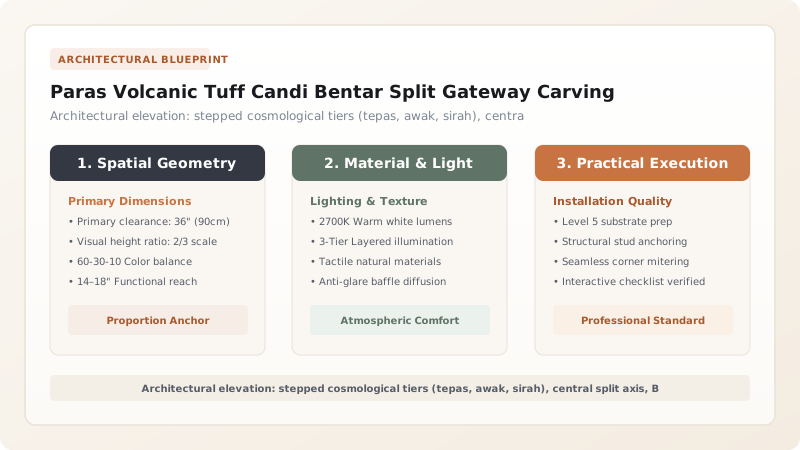
Volcanic Tuff Quarrying and Material Characteristics
The sculptural majesty of Balinese stone architecture is inextricably linked to the island’s active volcanic geology. Across centuries, monumental eruptions from the volcanic calderas of Mount Batur, Mount Agung, and the Bratan volcanic complex deposited thick strata of pyroclastic ash, volcanic glass shards, and fine pumice across the river valleys of central and southern Bali. Over millennia, groundwater percolation and geological compaction consolidated these loose ash deposits into soft, workable sedimentary rocks known in Indonesian as batu paras (volcanic tuff). The premier quarries are concentrated along the deep river ravines of Gianyar—most famously around the village of Silakarang—and the coastal plains of Badung (Kerobokan).
The defining physical attribute of freshly quarried batu paras is its high content of "quarry sap" (interstitial moisture). When extracted from deep riverbed pits using iron wedges and pickaxes, the stone is remarkably soft and ductile, possessing a Mohs hardness of barely 2 to 3. In this fresh, damp state, it can be planed with wooden scrapers and carved with steel chisels as easily as dense cheese or dry clay. However, as the stone is exposed to the atmosphere, the pore moisture evaporates, and dissolved silica and calcium minerals within the matrix migrate toward the exterior surface, crystallizing upon contact with air in a natural case-hardening process. Once fully cured, the exterior develops a resilient, durable crust that resists weathering, while maintaining high open porosity (typically 18% to 25%) that allows the stone to breathe freely in Bali’s humid equatorial climate.
Cosmic Symbolism of Mount Meru Cleaved in Two
The architecture of the Candi Bentar (split gateway) is among the most visually striking and philosophically profound features of Balinese vernacular culture. Unlike European triumphant arches or Indian toranas that span across an entrance portal, the Candi Bentar consists of two tall, symmetrical, mirror-image stone pylons that stand completely unjoined at the top, leaving an open, unobstructed vertical corridor framing the sky. The origin of this form is rooted in the ancient Javanese-Balinese myth of Mount Meru—the cosmic mountain that anchors the universe and serves as the dwelling place of the supreme gods.
According to sacred legend recounted in the Adiparwa, the gods transported Mount Meru from India to Java and Bali to stabilize the floating, restless islands. During its descent, the cosmic peak was split in two by divine force, creating the twin peaks of Mount Agung and Mount Batur. The Candi Bentar physically re-creates this cosmic event: the two halves of the gateway represent the split halves of the primordial mountain. When a worshipper or visitor walks through the gateway, they pass through the very center of the cleaved mountain. Symbolically, this passage functions as an energetic filter: the narrow, sheer vertical opening strips away external worldly attachments, chaotic thoughts, and malevolent spiritual influences (bhuta kala), purifying the mind before one steps foot into the sacred precincts of the temple or traditional domestic compound.
Carving Bhoma Masks, Kala Guardians, and Patra Foliage
The surface of a traditional Candi Bentar is an exuberant canvas of dense, high-relief sculptural iconography, executed by master stone sculptors known as sangging. Balinese stone carving is organized into a highly codified system of traditional motifs, categorized into figurative guardians, mythical beasts (karang), and botanical foliage (patra). Prominent among these is the monstrous face of Bhoma, carved in high relief with bulging eyes, snarling fangs, and wild, curling horns that dissolve into lush vegetation. Beneath Bhoma, master carvers sculpt the jaws of Kala—the god of time and destruction—whose open mouth swallows malevolent energies attempting to cross the threshold.
Flanking the portal openings are projecting corner bosses carved as mythical creatures: Karang Sae (a bat-like demon face), Karang Asti (an elephant head with upturned trunk), and Karang Goak (a monstrous raven beak). The transitional surfaces between these sculptural bosses are completely enveloped in patra punggel—rhythmic, undulating ribbons of curling fern fronds, lotus tendrils, and acanthus leaves that appear to writhe with living energy. The execution of these motifs requires extraordinary chisel mastery: carvers use razor-sharp V-parting chisels and curved spoon gouges to deeply undercut the stone, creating dramatic shadow lines and three-dimensional voids that make the stone figures leap outward from the wall under the shifting angles of equatorial sunlight.
Weathering Protection and Biological Growth Mitigation
Maintaining volcanic tuff carvings in a tropical environment characterized by over 2,500 millimeters of annual rainfall, high relative humidity (>80%), and intense solar ultraviolet radiation requires specialized conservation knowledge. Because batu paras is highly porous and contains volcanic glass and feldspar minerals, it is exceptionally hospitable to biological colonization. Within months of installation, bare stone surfaces are colonized by green and black cyanobacteria, followed by velvety bryophyte mosses (lumut) and crustose lichens.
In Balinese cultural aesthetics, this biological colonization is not automatically considered a defect; on the contrary, a gentle mantle of emerald-green moss on shaded gateway bases is revered as a living patina that signifies spiritual vitality and harmony with the natural elements. However, uncontrolled growth—particularly deep-rooting lichens and black crustose algae—can secrete organic acids (oxalic and citric acids) that dissolve the volcanic matrix, causing irreversible surface spalling and loss of crisp chisel facets. Traditional preservation relies on architectural water-shedding: master masons carve deep drip-grooves (tali air) beneath projecting stone moldings and install broad, overhanging stone coping slabs (lempeng) that throw rainwater away from carved relief faces. Periodic maintenance involves gentle brushing with soft coir brushes and rainwater; modern conservation treatments apply breathable, vapor-permeable ethyl silicate consolidants and potassium silicate water repellents that strengthen the stone matrix without creating an impermeable plastic film that traps internal moisture.
Volcanic Stone Varieties, Carving Workability & Architectural Roles in Bali
Use this reference table to calculate exact physical dimensions, ratios, and specifications before purchasing:
| Stone Variety | Geological Origin | Color & Texture | Carving Workability | Architectural Application |
|---|---|---|---|---|
| Paras Silakarang | Fine-grained volcanic ash tuff (Gianyar) | Warm cream to pale grey; silky fine grain | Extremely workable; holds razor-sharp relief | Intricate figurative sculptures, Bhoma masks, lintels |
| Paras Kerobokan | Pyroclastic volcanic tuff (Badung) | Mottled dark grey-black with basalt flecks | Medium hardness; highly weather-resistant | Monumental Candi Bentar portals, perimeter walls, plinths |
| Batu Candi (Andesite) | Dense volcanic basalt / andesite | Dark charcoal black; hard crystalline matrix | Difficult; requires diamond & carbide tools | Foundation footings, steps, water fountains, pavers |
| Paras Taro | Coarse volcanic agglomerate (Taro) | Light grey with visible pumice inclusions | Coarse workability; rustic texture | Outer temple boundary walls, rustic garden features |
| Batu Merah (Brick) | Fired terracotta clay brick | Warm reddish-orange; uniform fired density | Carved with files and dry-rubbed joints | Body walls of gates alternating with paras stone accents |
Practical Constraints
Every successful decoration project must account for physical and environmental constraints:
High porosity (18–25%) and softness of volcanic tuff under heavy monsoon downpours
Stone is prone to rapid colonization by black cyanobacteria, moss, and surface erosion. Mitigation: Incorporate wide projecting stone drip-edges (lempeng) and maintain proper drainage away from foundations.
Uneven settling of heavy stone gateway towers on soft alluvial volcanic soils
Differential settlement causes the two split halves to tilt inward or outward, binding access. Mitigation: Construct deep consolidated foundations of compacted basalt boulders bedded in hydraulic lime.
Execution Blueprint & Craftsmanship Sequence
Execute this professional sequence to achieve flawless results without backtracking:
Quarry Selection & Wet Transport
Select dense, fine-grained volcanic ash tuff (batu paras silakarang) from riverbed quarries in Gianyar. Keep blocks wrapped in wet straw during transport to preserve quarry sap.
Foundation & Plinth Construction
Excavate deep foundation trenches for both gateway pylons. Lay compacted basalt river boulders and build raised foundation plinths (tepas) using dressed red brick and volcanic stone.
Ashlar Squaring & Dry-Stack Rebating
Square volcanic tuff blocks to calibrated dimensions using broad steel scrapers. Mill interlocking horizontal tongues and grooves on mating faces to prevent lateral shifting.
Erecting the Gateway Pylons
Lay stone courses in tandem for both gateway halves, checking the inner portal faces with vertical plumb bobs to ensure perfectly parallel, mirror-image alignment.
Stepped Tier Layout (Undagi Profiling)
Mark the stepped profiles (pepalih) and cosmological divisions of the gateway tower: the base foot (tepas), the body (awak), and the stepped crown (sirah).
Rough-Out Chisel Carving (Bosting)
Using heavy flat chisels and wooden mallets (gandren), sculpt the monumental relief volumes: the guardian faces, projecting wings (sayap), and corner bosses.
Fine Relief Undercutting (Ngewang)
Employ fine curved gouges and V-parting chisels to carve intricate floral arabesques (patra punggel), bird motifs (patra sari), and sharp demonic fangs.
Joint Pointing & Breathable Conditioning
Pack all inter-stone joints with fine lime-sand slurry colored with pulverized volcanic stone dust. Rinse with water and apply breathable potassium silicate to stabilize crisp edges.
Common Mistakes & Countermeasures
Avoid these costly errors that compromise aesthetics, ergonomics, and budget:
Carving dry, aged volcanic tuff that has lost its quarry moisture
Failing to align the internal vertical planes of the two Candi Bentar split halves
Sealing soft volcanic stone with impermeable acrylic coatings or glossy sealers
Project Execution Checklist
Track your physical progress. Checkboxes persist automatically on this device:
Frequently Asked Questions
Why is volcanic tuff (batu paras) the preferred medium for Balinese temple carving?
Batu paras is a pyroclastic volcanic rock formed from consolidated volcanic ash, pumice, and feldspathic glass deposited during ancient eruptions of Bali's volcanic peaks (such as Mount Batur and Mount Agung). When freshly quarried, it contains "quarry sap" (pore moisture) that makes it remarkably soft, pliable, and easy to carve with simple steel chisels. This softness allows Balinese master sculptors to achieve extraordinary depths of three-dimensional undercutting, delicate filigree, and expressive figurative detail that would be impossible in hard granite or dense basalt. Over time, exposure to air dries the stone, causing it to harden significantly.
What does the mythological Bhoma mask represent on a Balinese gateway?
Bhoma (also known as Vanaspati, "Lord of the Forest") is a central protective deity in Balinese Hindu mythology, born of the union between the earth goddess Dewi Pertiwi and the creator god Vishnu. Depicted as a terrifying face with bulging eyes, flaring nostrils, snarling fangs, and hands grasping foliage, Bhoma represents the fierce generative and protective power of nature. When carved directly above the gateway opening, Bhoma serves as a spiritual guardian that swallows and neutralizes evil thoughts, impurities, and negative spiritual forces before worshippers or guests cross the threshold.
How do Balinese artisans maintain stone carvings that are colonised by green moss and lichen?
In Balinese aesthetics, the growth of fine green moss (lumut) and velvety lichen on volcanic stone is not viewed as damage, but as a revered living patina that signifies spiritual vitality and harmony with nature. However, destructive thick root systems or black algae crusts that degrade stone details are managed carefully. Artisans gently clean historic carvings using soft coconut-fiber brushes and fresh water—never high-pressure water washers or harsh chemical biocides, which shatter the delicate, porous volcanic stone facets.