
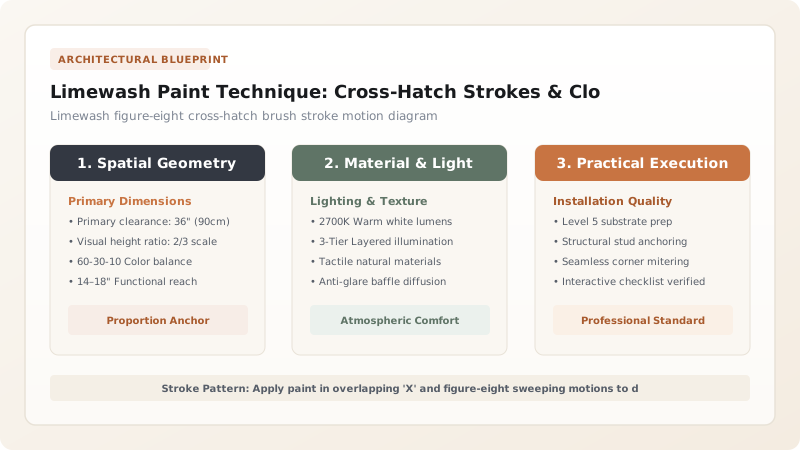
Apply limewash paint by rolling a specialized mineral primer first, then applying two coats of limewash using a 5-inch block brush in loose figure-eight and overlapping 'X' cross-hatch strokes. Keep a continuous wet edge from corner to corner to prevent lap lines.
At a Glance: Key Takeaways
- Brush Choice: 5 to 6-inch natural bristle masonry block brush.
- Stroke Motion: Figure-eight and overlapping multi-directional 'X' strokes.
- Water Dilution: Dilute 2nd coat with 10-15% water for translucent feathering.
- Continuous Edge: Never stop halfway across a wall; work corner-to-corner.
1. Why Limewash Creates Organic Tonal Clouding
Unlike standard synthetic latex paint that dries into a flat plastic film, limewash is slaked lime and natural earth pigments. As moisture evaporates, the lime undergoes carbonation with atmospheric CO2, causing thicker brush strokes to dry lighter and thinner areas to dry deeper.

Limewash Coat Specifications
Use this reference table to calculate exact physical dimensions, ratios, and specifications before purchasing:
| Coat Stage | Dilution Ratio | Brush Technique | Drying Time Before Next Coat |
|---|---|---|---|
| 1. Mineral Primer | 0% (Full strength) | Standard 3/8" roller | 12 hours (Full cure) |
| 2. Limewash 1st Coat | 0% - 5% Water | Broad overlapping X strokes | 4 - 6 hours |
| 3. Limewash 2nd Coat | 10% - 15% Water | Loose, feathering figure-eight | 24 hours (Full bloom) |
| 4. Protective Sealer | 0% (Full strength) | Fine foam roller or soft brush | 12 hours |
Touch-Up & Patching Constraints
Every successful decoration project must account for physical and environmental constraints:
Spot Touch-Ups Leaving Dark Patches
Dabbing a spot of limewash in the center of a dry wall leaves a dark halo ring; scuffs must be feathered broadly across the full wall section.
How to Paint a Limewash Accent Wall
Execute this professional sequence to achieve flawless results without backtracking:
Apply Mineral Primer
Roll acrylic quartz primer to give the drywall mineral tooth.
Stir Paint Continuously
Mix limewash bucket frequently to keep heavy mineral pigments in suspension.
Brush in Figure-Eights
Work 3x3 foot sections with a 5-inch block brush in sweeping X motions.
Apply Diluted 2nd Coat
Dilute with 10% water and feather second coat over cured base.
Common Mistakes & Countermeasures
Avoid these costly errors that compromise aesthetics, ergonomics, and budget:
Using a Paint Roller for Limewash
Project Execution Checklist
Track your physical progress. Checkboxes persist automatically on this device:
Frequently Asked Questions
Can you paint regular paint over limewash later?
Yes. If you decide to change wall colors years later, simply apply a good quality bonding primer over the cured limewash, after which you can apply standard latex paint or wallpaper.


