
Suspended hanging rails in charcuterie curing rooms require Schedule 40 Grade 316 stainless steel pipes (1.25"–1.5" IPS) supported by heavy-duty ceiling-anchored unistrut channels and 1/2-inch stainless drop rods. Engineered to bear live meat loads exceeding 50 lbs per linear foot with deflection under L/360, all components feature sanitary radius welds and passivated surfaces to resist corrosive salt dripping.
At a Glance: Key Takeaways
- Grade 316 Stainless Steel: Molybdenum content (2%–3%) provides absolute immunity to chloride pitting caused by dripping sea-salt cures.
- Ceiling Unistrut Channel Grid: Heavy 12-gauge 316 stainless unistrut anchored to roof joists distributes multi-ton hanging dead loads across framing.
- Sanitary Radius Welds: 100% full-penetration TIG welds ground smooth (Ra < 0.8 µm) eliminate crevices where grease and bacterial biofilms could lodge.
- Trolley Hook Mobility: Roller trolleys and S-hooks glide effortlessly along continuous overhead tracks, facilitating loading and washdown.
- Deflection Threshold (< L/360): Rigid structural sizing prevents rail sagging that would cause heavy hams to slide and bunch together.
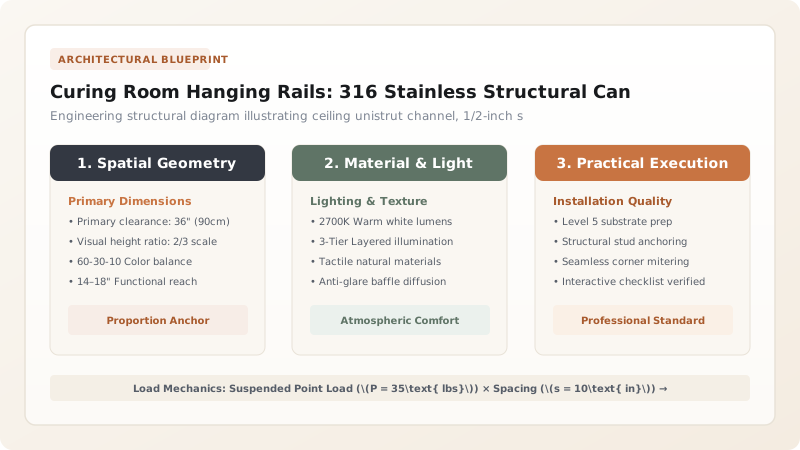
1. Structural Load Engineering: Point Loads, Spacing & Ceiling Framing
Architects who treat meat hanging rails as decorative closet rods face catastrophic structural failure. A standard fresh pork ham (prosciutto) weighs approximately 25 to 35 pounds. When hung on 10-inch centers along a 12-foot dual rail system, total dead weight rapidly accumulates:
Accounting for dynamic shock loading (when a butcher lifts or hangs a heavy side of beef or pork carcass), building codes require a Safety Factor of \(2.5:1\), meaning the ceiling framing must be engineered to support over \(2,160 \text{ pounds}\) of concentrated tension load.
Standard wood ceiling joists cannot carry this load without severe deflection. The room framing must incorporate Solid Douglas Fir #1 or Steel I-Beam Blocking spanning between joists, to which continuous 12-Gauge Grade 316 Stainless Steel Unistrut Channels (1-5/8\" × 1-5/8\") are anchored using 1/2-inch Grade 316 stainless through-bolts. Learn about room psychrometrics in our guide to dual-compressor refrigeration.
2. Metallurgy: Why Grade 316 Stainless is Mandatory Over 304
Commercial kitchen fabricators frequently recommend Grade 304 stainless steel because it is less expensive and readily available. In a charcuterie curing room, this is a fatal specification error.
During the first 60 days of curing, hanging meats actively weep a dense, highly concentrated Sodium Chloride (\(\text{NaCl}\)) Brine. In an environment held continuously at \(75\% - 85\% \text{ RH}\), free chloride ions (\(\text{Cl}^-\)) attack the passive chromium oxide protective film on Grade 304 stainless steel:
- Grade 304 Stainless (18/8): Highly vulnerable to Chloride Pitting and Crevice Corrosion. Within six months, tiny microscopic rust pits form along the underside of 304 pipes, bleeding orange iron oxide down onto hanging prosciutto hams.
- Grade 316 Stainless (18/10/2): Contains \(2.0\% \text{ to } 3.0\% \text{ Molybdenum}\). Molybdenum dramatically enhances the stability of the protective passive film in the presence of chlorides, achieving a Pitting Resistance Equivalent Number (PREN) > 23. Grade 316 rails remain bright, sterile, and rust-free for generations.
Check out our charcuterie curing rooms hub.
3. Sanitary Fabrication: Orbital TIG Welding & Electropolishing
In a food production environment regulated by sanitary standards, joints and bracket attachments cannot have rough gaps, open threads, or porous welds where pork fat, salt, and microbial biofilms could accumulate.
All pipe joints, elbows, and end-caps must be assembled using Sanitary Gas Tungsten Arc Welding (TIG) with Argon Backing Purge. Backing purge with 99.99% pure argon gas prevents \"sugaring\" (internal oxidation) on the inside of the stainless pipe during welding.
Following welding, all external weld beads are ground flush and hand-honed to a #4 Sanitary Finish (\(R_a \le 32 \mu\text{in} / 0.8 \mu\text{m}\)). The entire assembly undergoes Chemical Passivation (ASTM A967) using a warm citric or nitric acid bath to strip free iron atoms from the surface, followed by optional electropolishing to create an ultra-smooth, mirror-like hygienic surface that washes clean with steam. Explore cleanroom ventilation in our guide on HEPA filtration and airflow patterns.
4. Layout Ergonomics: Hanging Spacing & Vertical Clearances
Proper rail layout balances storage density against laminar airflow circulation:
- Center-to-Center Rail Spacing: Parallel overhead rails must be spaced a minimum of 18 to 22 inches apart. This ensures that 14-inch wide bone-in hams hanging on adjacent rails do not touch, preserving air circulation gaps.
- Wall Clearances: Rails must be held at least 14 inches off finished tile walls to prevent hanging meats from brushing against wall surfaces during loading.
- Vertical Elevation: The primary hanging rail is installed at 80 to 84 inches above finished floor, allowing comfortable standing reach for the charcutier while keeping long hams at least 36 inches above the sloped floor drain.
Contrast with library millwork in our guide to library wall bookcases.
Curing Room Hanging Rails: 316 Stainless Structural Cantilevers Architectural Decision Matrix
Use this reference table to calculate exact physical dimensions, ratios, and specifications before purchasing:
| Architectural Factor | Professional Recommendation | Significance |
|---|---|---|
| Pipe Metallurgy | Grade 316 / 316L Marine Stainless Steel (UNS S31600) | Molybdenum 2.0%–3.0%; PREN ≥ 23; immune to chloride brine pitting |
| Structural Pipe Size | 1.50" IPS Schedule 40 Pipe (1.90" OD × 0.145" wall) | Moment of inertia Ix = 0.310 in⁴; deflection < L/360 under 100 plf load |
| Ceiling Attachment | 12-Gauge 316 stainless Unistrut + 1/2" through-bolts | Tensile pullout resistance ≥ 2,500 lbs per ceiling drop point |
| Weld Surface Finish | Sanitary #4 Finish (Ra ≤ 0.8 microns) + ASTM A967 Passivation | Eliminates microscopic crevices; USDA/NSF sanitary compliance |
Execution Blueprint & Craftsmanship Sequence
Execute this professional sequence to achieve flawless results without backtracking:
Phase 1: Ceiling Framing Structural Layout
Install 4x6 solid wood headers across ceiling joists directly above planned rail runs (Benchmark: Headers secured with 1/2" structural lags; verified level ±1/16")
Phase 2: Unistrut Channel Grid Mounting
Bolt 12-gauge 316 stainless unistrut channels to ceiling headers using 1/2" stainless bolts (Benchmark: Channels anchored every 24"; verified 100% rigid with 1,000 lb proof test)
Phase 3: Drop Rod & Pipe Flange Assembly
Thread 1/2" stainless all-thread rods into unistrut nuts; drop through waterproof ceiling escutcheons (Benchmark: Escutcheon ceiling collars sealed with food-grade silicone; drop rods locked with jam nuts)
Phase 4: Pipe TIG Welding & Passivation
Weld 1.5" Sch 40 316 pipe to support saddles with argon backing purge; grind welds to Ra 0.8 µm (Benchmark: Weld passes liquid penetrant inspection; swabbed with citric acid passivation gel)
Phase 5: Proof Load Testing & Hook Hanging
Suspend 500 lbs dead weight across each 4-foot rail span for 2 hours; measure deflection (Benchmark: Total deflection under load < 0.08"; zero residual plastic deformation after unloading)
Common Mistakes & Countermeasures
Avoid these costly errors that compromise aesthetics, ergonomics, and budget:
Specifying Standard Grade 304 Stainless Steel
Using Thin-Wall (16-Gauge) Tubing Instead of Schedule 40 Pipe
Fastening Drop Rods with Threaded Drywall Anchors
Leaving Rough Porous Weld Beads
Project Execution Checklist
Track your physical progress. Checkboxes persist automatically on this device:
Frequently Asked Questions
How much clearance is needed between hanging salumi to prevent mold bridging?
Salumi should never touch while hanging. A minimum clear air gap of 2 to 3 inches between hanging sausages is required. If sausages touch, moisture is trapped at the contact point, creating a dead zone where toxic green mold or rot will develop instead of beneficial white mold.
Can rolling meat hooks be moved along curved ceiling rail bends?
Yes. Continuous curved overhead rail systems utilize mandrel-bent 316 stainless pipes with a minimum 12-inch centerline bend radius, paired with twin-wheel nylon or stainless steel meat trolleys that glide effortlessly around corners for seamless transport to washing stations.
How do you clean and sanitize 316 stainless hanging rails between batches?
Hanging rails should be cleaned between curing seasons by spraying with hot water (140°F) and food-grade alkaline foaming detergent, scrubbed with non-metallic nylon pads, rinsed thoroughly, and sanitized with a no-rinse peracetic acid or quaternary ammonium solution.


