
Decorate a teen bedroom by dividing the room into sleep, study, and social lounge zones, integrating customizable LED strip accent lights, setting up a 36-inch ergonomic study desk with multi-device charging, and mounting wire grid photo walls for self-expression.
At a Glance: Key Takeaways
- Teen bedrooms serve as full micro-apartments for sleeping, studying, and hosting friends.
- Smart RGBW LED strips offer customizable mood lighting popular with teenagers.
- Wire grid photo walls allow easy updating of posters and photos without damaging paint.
- A small bean bag or saucer chair creates a dedicated lounge corner.
In-Depth Guides in this Directory
Explore specialized subtopic blueprints, technical dimensions, and execution checklists:
Teen Study Space Decor: Focus Desks, Pinboards & Ergonomics
Design productive teen study spaces: 42-inch desks, high-back mesh chairs, multi-device power hubs, pegboards, and anti-glare lamps.
Teen Room Storage: Wardrobe Organization, Tech Shelves & Shoe Racks
Organize teen bedrooms with modular wardrobes, tech shelving, sneaker display racks, laundry hampers, and backpack hooks.
Teen Room Lighting: LED Strip Accent, Task Sconces & Ambient Mood Light
Plan teen room lighting: RGBW LED tape lights, app-controlled dimmers, study task sconces, and atmospheric floor lamps.
1. Adolescent Spatial Psychology & Multi-Functional Zoning
Designing and decorating a teen bedroom requires an intentional shift away from child-centric decor paradigms toward an adaptable, adult-adjacent spatial architecture. During adolescence, a bedroom ceases to function merely as a place to sleep and store clothing; it transforms into a primary sanctuary for identity formation, academic rigor, private emotional decompression, and peer socialization. An effectively designed teen bedroom must balance the teenager's emerging desire for creative self-expression with rigorous organizational structure, ergonomic support, and long-term aesthetic durability.
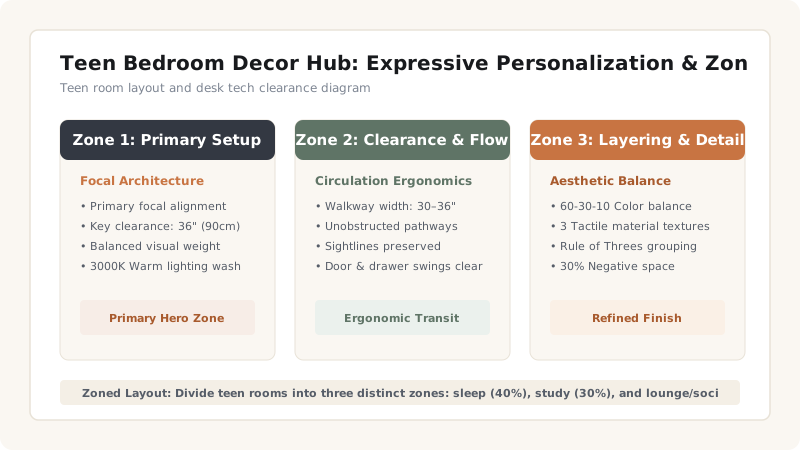
To prevent spatial conflict and visual chaos, the room layout must be partitioned into three distinct, non-overlapping architectural zones:
- The Rest & Sleep Sanctuary: Centered around a full-size (54x75 inch) or queen-size (60x80 inch) mattress platform equipped with high-durability, hypoallergenic, breathable natural linens and dimmable 2700K warm circadian ambient lighting.
- The Academic & Focus Workstation: An ergonomically optimized study plane featuring a 30x60 inch desk, an adjustable lumbar-support task chair, anti-glare 4000K neutral-white task lighting, and integrated cable raceways to support laptops, tablets, and academic textbooks.
- The Social & Decompression Lounge: A secondary conversational corner incorporating flexible modular lounge seating—such as low-profile floor poufs, a compact futon chair, or an upholstered bench—allowing peers to socialize without congregating directly on the unmade bed.
Maintain at least 32 to 36 inches of clear circulation pathways connecting the room entry door, wardrobe access, and study desk to ensure effortless daily navigation.
2. Material Selection, Performance Textiles & Modular Joinery
Material choices in teen spaces must withstand heavy, multi-use wear without sacrificing sophisticated design. Avoid flimsy, trend-driven novelty furniture that becomes obsolete within eighteen months. Instead, invest in neutral architectural foundations constructed from solid hardwoods (such as white oak, birch, or maple), powder-coated structural steel, and high-pressure laminates that resist pen indentations, beverage spills, and heat rings.
For upholstery and soft furnishings, specify commercial-grade performance fabrics treated with non-fluorochemical stain-resistant finishes (such as Crypton, Sunbrella indoor, or tightly woven polyester chenille) with Wyzenbeek abrasion ratings exceeding 30,000 double rubs. Bedding should prioritize 100% long-staple washed cotton percale or natural European flax linen, both of which soften with repetitive laundering, provide superior thermal regulation, and resist static cling.
Modular joinery represents the gold standard for adolescent storage. Implement a wall-mounted modular rail system (such as Vitsoe 606 or modular slotted hardwood standards) that allows open bookshelves, desk surfaces, and hanging storage components to be reconfigured vertically as the teenager grows and their hobbies evolve from childhood sports or music instruments into university preparation.
3. Three-Tier Circadian Lighting & Acoustic Engineering
Adolescent sleep cycles are biologically shifted toward later circadian rhythms, making light management critical for cognitive health and academic performance. A poorly lit teen room relying on a harsh center flushmount bulb disrupts melatonin production at night while creating debilitating eye strain during late-night study sessions.
Implement an adaptable three-tier illumination strategy:
- Tier 1: Ambient Base Illumination (200-250 Lux): Diffused dimmable ceiling wash lighting or a modern fabric drum pendant providing 3000K warm-white ambient light for general room orientation.
- Tier 2: Ergonomic Task Lighting (450-500 Lux at Desk): An articulated LED architect desk lamp with 4000K neutral light and 90+ CRI positioned to eliminate hand shadowing across written assignments and keyboard surfaces.
- Tier 3: Controllable Accent & Mood Illumination: High-density 24V COB (Chip-on-Board) smart LED strips concealed inside frosted aluminum channels mounted behind headboards, beneath floating wall shelves, or within closet valances. Dotless smart LEDs allow the teenager to personalize color scenes (from energizing daylight to calming lavender) via smartphone apps without visual clutter.
Acoustic dampening is equally crucial, particularly for teens who practice musical instruments, produce digital audio, or engage in voice chat gaming. Lay a dense 1/2-inch felt underlayment beneath a heavyweight wool or flatweave rug to deaden foot impact noise, and install full-length fabric blackout curtains to absorb external traffic noise and interior flutter echoes.
4. Display Curations, Art Walls & Wardrobe Storage Discipline
Teenagers require dedicated, designated zones to express personal agency without damaging wall surfaces or inducing visual clutter. Taping posters directly onto drywall leads to torn paint, ragged paper corners, and a chaotic aesthetic.
Provide intentional gallery systems: install a 48x36 inch linen-wrapped acoustic bulletin board, a magnetic powder-coated steel rail with magnetic clips, or a series of matching slim black aluminum picture ledges with 2-inch lips. Picture ledges allow teens to rotate concert posters, art prints, vinyl records, and photo collages effortlessly without driving a single nail into the wall.
In the closet, maximize vertical capacity with a double-hang rod system (upper rod at 80 inches, lower rod at 40 inches from floor) to separate hoodies, shirts, and trousers. Incorporate a stack of clear-front acrylic drawers or wire pull-out baskets for athletic gear and shoes, paired with heavy-duty over-the-door hooks for backpacks, hats, and jackets.
Teen Bedroom Typologies & Specification Matrix
Use this reference table to calculate exact physical dimensions, ratios, and specifications before purchasing:
| Typology | Primary Focus | Desk & Workstation | Lounge / Social Seating | Acoustic & Tech Feature |
|---|---|---|---|---|
| Academic Scholar | Deep study, textbook storage & quiet | 30x60" Hardwood desk with hutch | Ergonomic reading armchair | Acoustic cork wall + 4000K task lighting |
| Creative Studio / Maker | Art, sketching, digital media creation | Adjustable drafting table + tool cart | Modular floor poufs & daybed | Pegboard organization + smart LED coving |
| Gamer / Tech Haven | Dual-monitor gaming, streaming & code | 32x64" Cable-managed steel desk | Ergonomic mesh rocker or beanbag | Under-desk cable raceways + acoustic foam |
| Minimalist Sanctuary | Clutter-free calm & wellness retreat | Floating 20x48" wall-mounted desk | Low upholstered storage bench | Heavy linen blackout drapes + hidden storage |
Teen Room Architectural Constraints
Every successful decoration project must account for physical and environmental constraints:
Rapidly Evolving Aesthetic Preferences
Teens outgrow trend-specific decor within 12 to 24 months; keep expensive structural elements (flooring, bed frame, closet cabinetry, wall paint) neutral and timeless, allowing personalization through easily swapped posters, textiles, and LED lighting scenes.
High Tech Power & Cable Demand
Laptops, gaming consoles, phones, tablets, and headphones create hazardous cable nests; install under-desk steel cable management raceways and specify power strips with surge protection and USB-C Power Delivery ports.
Floor Clutter & Laundry Accumulation
Clothing frequently piles on floor planes; install open-top canvas laundry hampers directly adjacent to the closet and provide ample perimeter hooks for daily jackets and bags.
How to Style a Teen Bedroom
Execute this professional sequence to achieve flawless results without backtracking:
Place Full Size Bed
Position full-size bed centered against accent wall.
Set Up Study Workstation
Assemble a 42-inch desk with ergonomic mesh chair near window.
Hang Wire Photo Grid
Mount a black metal wire grid above desk for photos and notes.
Install Accent LED Strip
Adhere smart LED tape light along the back edge of the headboard.
Common Mistakes & Countermeasures
Avoid these costly errors that compromise aesthetics, ergonomics, and budget:
Imposing Rigid Adult Decor Without Teen Input
Undersized Twin Bedding in Growing Years
Direct Tape Mounting on Drywall
Project Execution Checklist
Track your physical progress. Checkboxes persist automatically on this device:
Frequently Asked Questions
What is the best bed size for a teenager's bedroom?
A full-size (double) mattress measuring 54x75 inches provides the optimal balance of sleeping comfort, longevity through late adolescence, and floor spatial economy. In narrow rooms under 100 square feet, a Twin-XL (38x80 inches) provides essential legroom for tall teens while preserving floor area for desks and seating.
How can a teenager personalize their bedroom without damaging walls?
Install horizontal wooden picture ledges with shallow lips, large linen-wrapped cork bulletin boards, magnetic stainless steel wall rails, and peel-and-stick repositionable fabric wallpaper murals. These systems allow constant rotation of posters, photos, and artwork without puncturing drywall or peeling paint.
What lighting color temperature is recommended for teen study and sleep balance?
Use dual-mode lighting: 4000K neutral white task lighting (450-500 Lux) at the study desk to promote daytime cognitive alertness, paired with dimmable 2700K warm-white ambient lighting and smart RGB LED accent strips programmed to shift to warm amber or red tones two hours before bedtime to support melatonin release.
How do you manage clutter and laundry in a teen bedroom?
Eliminate friction in tidying: use lidless open-top canvas hampers, replace traditional closet door hangers with wide wall-mounted peg rails, and provide pull-out wire baskets inside wardrobes so clothes can be sorted quickly without meticulous folding.
What desk dimensions are necessary for modern teen academic work?
A modern teen desk should measure at least 48 to 60 inches wide and 24 to 30 inches deep. This comfortably accommodates a 24-to-27 inch monitor or laptop, mousepad, and an open spiral notebook or textbook side-by-side with 28 to 30 inches of legroom underneath.


