
Insulate wood-fired pizza oven hearth floors by laying 2 inches of high-density calcium silicate board (18 to 22 lbs/cu.ft density / 1,800°F service rating) over the concrete support slab. This provides an R-10 thermal break that stops cold concrete from draining heat, keeping cooking bricks at 850°F+ for hours.
At a Glance: Key Takeaways
- Eliminates Concrete Thermal Siphoning: Concrete has high thermal conductivity (\(k = 1.3\text{ W/mK}\)), which chills raw firebrick floors.
- 1,800°F (1,000°C) Temperature Rating: Completely non-combustible inorganic mineral matrix that never off-gasses or degrades.
- High Compressive Strength (140+ PSI): Supports thousands of pounds of firebrick dome weight without crushing or settling.
- 2-Inch (50mm) Thickness Standard: Delivers an R-10 thermal insulation value in a compact, easily cut rigid sheet.
- Easy Workability: Cuts cleanly with standard wood hand saws, jigsaws, or utility knives.
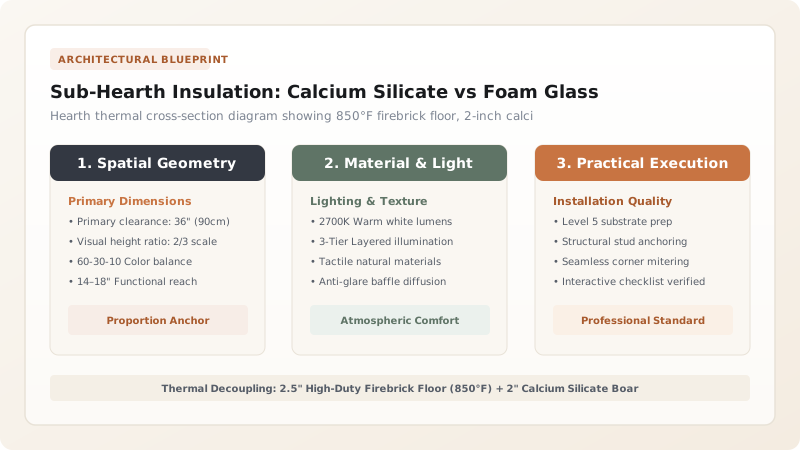
1. Thermodynamics: Concrete Thermal Siphoning vs Calcium Silicate
When fire heats hearth bricks to \(850^{\circ}\text{F}\), heat flows rapidly toward cold matter via conduction. Standard structural concrete has a high Thermal Conductivity (\(k = 1.3\text{ W/m}\cdot\text{K}\)), acting like an open drain that robs thermal energy from the oven floor.
High-Density Calcium Silicate Board (Skamol / Promat Promasil) has an ultra-low Thermal Conductivity of \(k = 0.06\text{ W/m}\cdot\text{K}\) (over 20x better thermal insulation than concrete). Installing a 2-inch board maintains an R-10 Thermal Barrier, ensuring that 100% of stored fire heat remains trapped in the cooking floor. Learn dome construction in Pompeii dome firebrick math.

2. Compressive Rigidity (140 PSI) & Staggered Installation
Unlike soft ceramic fiber blankets that compress and squash under heavy weight, high-density calcium silicate board has a compressive strength of over 140 PSI (1.0 MPa). It easily supports the 1,500-lb weight of a solid firebrick dome without crushing or sagging.
Lay two 1-inch layers or a single 2-inch board in a staggered joint pattern over the concrete slab, sealing with thinset mortar. Combine with dual-flue chimney designs.
Sub-Hearth Insulation Materials Comparison
Use this reference table to calculate exact physical dimensions, ratios, and specifications before purchasing:
| Insulation Material | Thermal Conductivity (k) | Compressive Strength | Best Application |
|---|---|---|---|
| Calcium Silicate Board (Optimal) | 0.06 W/m·K (R-5 / inch) | 140 - 180 PSI (Rigid) | Heavy firebrick pizza oven hearth floors |
| Expanded Cellular Foam Glass (FOAMGLAS) | 0.04 W/m·K (R-3.8 / inch) | 100 PSI (Moisture proof) | Below-grade & wet exterior hearth bases |
| Ceramic Fiber Board | 0.07 W/m·K (R-4.5 / inch) | 70 PSI (Moderate) | Under hearth and oven dome insulation |
| Perlite / Vermiculite Concrete Mix | 0.18 W/m·K (Low R-value) | 50 PSI (Spongy / takes weeks to dry) | Budget alternative (Requires 4" depth) |
Water Absorption Freeze Shatter Constraints
Every successful decoration project must account for physical and environmental constraints:
Rainwater Soaking Calcium Silicate Board Freezing and Disintegrating
Calcium silicate is hydrophilic and absorbs rainwater; freezing temperatures cause water-soaked board to delaminate; always waterproof the perimeter stucco shell with a breathable elastomeric sealant, and flash the chimney base to keep the under-hearth bone-dry.
How to Install Calcium Silicate Sub-Hearth Insulation
Execute this professional sequence to achieve flawless results without backtracking:
Clean and Level Concrete Pedestal Slab
Sweep slab surface; grind down high spots so the base is dead-flat to within 1/16".
Apply Medium-Bed Modified Thinset Mortar
Trowel polymer-modified thinset over concrete with a 1/2" square-notched trowel.
Lay 2" Calcium Silicate Boards Staggered
Bed boards into thinset, staggering all butt joints by at least 12 inches to eliminate thermal breaks.
Cut Perimeter Circular Curve with Handsaw
Scribe oven dome outer footprint and cut away excess board using a coarse-tooth hand saw.
Dry-Lay Firebrick Floor on Top of Board
Lay 2.5" thick refractory firebrick floor directly on dry calcium silicate with zero mortar.
Level Hearth Bricks with Rubber Mallet
Tap firebricks dead-flush with rubber mallet to create a seamless snag-free pizza peel sliding floor.
Common Mistakes & Countermeasures
Avoid these costly errors that compromise aesthetics, ergonomics, and budget:
Using Mortar Between the Calcium Silicate Board and the Firebrick Floor
Project Execution Checklist
Track your physical progress. Checkboxes persist automatically on this device:
Frequently Asked Questions
Can you use home attic fiberglass insulation under a pizza oven hearth?
ABSOLUTELY NOT! Fiberglass insulation melts at 1,000°F and compresses to zero thickness under brick weight, creating an extreme fire hazard. Only use rigid, certified calcium silicate or ceramic fiber boards.


