
Tame boomy low-frequency bass in home theaters by building floor-to-ceiling corner bass traps filled with 4 to 6 inches of high-density mineral wool (Rockwool Safe'n'Sound or Owens Corning 703). Straddling corner angles at 45 degrees creates an air gap behind the trap that dramatically improves 50–100 Hz absorption.
At a Glance: Key Takeaways
- Maximum Pressure Node: Sound pressure quadruples in the 3-plane intersection of tri-corners (ceiling-wall-wall).
- 4-to-6-Inch Mineral Wool Core: High gas-flow resistivity (10,000–16,000 Pa·s/m²) converts acoustic energy into heat.
- The 45° Corner Straddle: Mounting a flat 24-inch wide panel across a 90° corner creates a trapped air spring behind it.
- Limp-Mass Membrane Traps: Specialized sealed membrane boxes target ultra-low resonant peaks below 50 Hz.
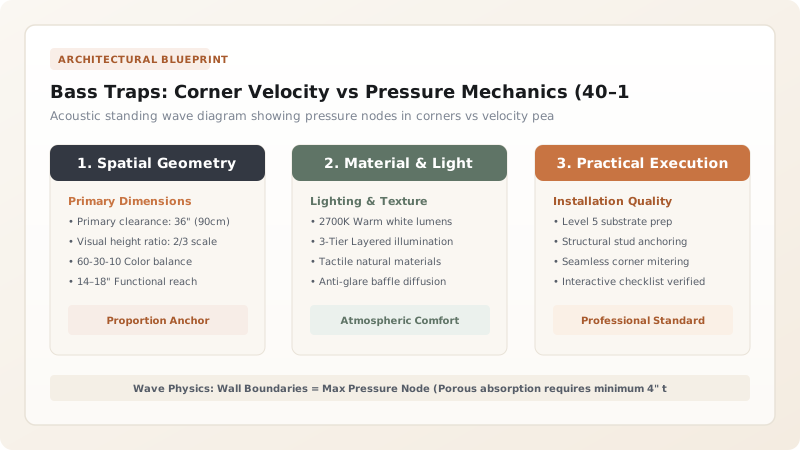
1. Wave Mechanics: Particle Velocity vs Boundary Sound Pressure
Sound energy exists as two alternating components: Sound Pressure and Particle Velocity. At a solid boundary (like a drywall corner), particle velocity drops to zero while acoustic sound pressure reaches its absolute maximum peak.
Standard 1-inch foam panels placed on flat walls fail to absorb bass because low-frequency velocity is zero at the wall face. By straddling a 4-inch dense mineral wool panel across a 90-degree corner, the absorber sits several inches away from the rigid wall boundary—right in the high-velocity zone where viscous thermal friction dissipates the sound wave.

Bass Trap Types & Acoustic Performance by Depth
Use this reference table to calculate exact physical dimensions, ratios, and specifications before purchasing:
| Bass Trap Design | Internal Core Material | Effective Frequency Range | Installation Form Factor |
|---|---|---|---|
| 45° Corner Straddle Panel (Optimal) | 4" Owens Corning 703 / Rockwool | 60 Hz - 300 Hz | 24" Wide panel straddling 90° corner |
| Full Triangular Superchunk Trap | Solid solid-core mineral wool fill | 40 Hz - 250 Hz (Extreme bass) | Full floor-to-ceiling solid corner triangle |
| Tuned Limp-Mass Membrane Trap | Loaded vinyl membrane in sealed box | 35 Hz - 80 Hz (Narrow notch) | Flat wall-mount shallow box (4" deep) |
| 1" Polyurethane Foam Wedge (Toy) | Cheap 1 lb/cu ft open-cell foam | 800 Hz+ only (Zero bass) | FAILS: Ineffective on subwoofer frequencies |
Mineral Wool Fiber Itch & Dust Constraints
Every successful decoration project must account for physical and environmental constraints:
Microscopic Fiberglass Dust Shedding into Room Air from Bass Traps
Raw mineral wool fibers cause skin irritation and respiratory issues if exposed; wrap the internal insulation tightly in 0.5-mil poly sheeting or a non-woven breathable barrier (like polyester batting) before stretching outer decorative fabric.
How to Build a Corner Straddle Bass Trap
Execute this professional sequence to achieve flawless results without backtracking:
Build 1x4 Poplar Outer Frame
Construct a 24" W × 48" H (or floor-to-ceiling) frame from 1x4 poplar with pocket screws.
Insert 4" Dense Mineral Wool
Friction-fit 4-inch thick Owens Corning 703 or Rockwool Safe'n'Sound into frame cavity.
Wrap with Protective Batting
Cover insulation in non-woven polyester batting to contain all loose mineral fibers.
Stretch Class-A Acoustic Fabric
Staple breathable acoustic textile (Guilford of Maine) tightly across the front and sides.
Mount Across Corner at 45°
Fasten to wall studs with heavy-duty aluminum Z-clips, leaving the triangular air cavity open behind.
Common Mistakes & Countermeasures
Avoid these costly errors that compromise aesthetics, ergonomics, and budget:
Installing Bass Traps in Only 1 or 2 Corners Instead of All 4
Project Execution Checklist
Track your physical progress. Checkboxes persist automatically on this device:
Frequently Asked Questions
Does wrapping a bass trap in thin plastic hurt high-frequency absorption?
Wrapping bass traps in ultra-thin 0.5-mil plastic actually helps! The plastic reflects high frequencies back into the room (preventing the space from sounding overly dead) while allowing long low-frequency bass waves to pass right through into the mineral wool.


