
Complete authentic French Chateau salons by centering an antique carved Carrara marble chimneypiece topped with an integrated *trumeau* overmantel mirror featuring antique distressed mercury glass and carved gilded moldings. Fit all tall French casement doors and windows with solid cast brass surface-mounted *crémone* bolts with dual opposing locking rods.
At a Glance: Key Takeaways
- Integrated Trumeau Overmantel Mirrors: Wood-framed mirrors integrated directly into the boiserie paneling above marble fireplaces.
- Antique Distressed Mercury Glass: Subtle silvering desaturation, dark mercury spots, and champagne reflections evoking 18th-century mirrors.
- Solid Cast Unlacquered Brass Crémone Bolts: Traditional surface-mounted turn-handle rods that lock casements at top and bottom headers.
- Carved French Marble Chimneypieces: Serpentine Louis XV mantels carved from Carrara white, Saint Laurent black, or Campan rose marble.
- Concealed Jib Doors (*Portes Dérobées*): Secret boiserie paneled doors that blend invisibly into the wall without frames or visible hinges.
1. Focal Architecture: Trumeau Overmantel Mirrors & Mercury Glass Patina
Modern hanging mirrors look like an afterthought. In 18th-century French salons, the chimneypiece and mirror are A Single Monolithic Architectural Composition.
The Trumeau Mirror is built directly into the wall boiserie, featuring a Carved Gilded Crown Crest (*Fronton*) over Antique Distressed Mercury Glass that reflects candlelight with warm champagne tones. Master Versailles parquet in Versailles pattern parquet.

2. Hardware Engineering: Solid Brass Crémone Bolts & Espagnolettes
Tall French casement doors (8 to 10 feet high) bow under wind pressure if held only by a center latch. French architects utilize Surface-Mounted Brass Crémone Bolts (*Crémones*).
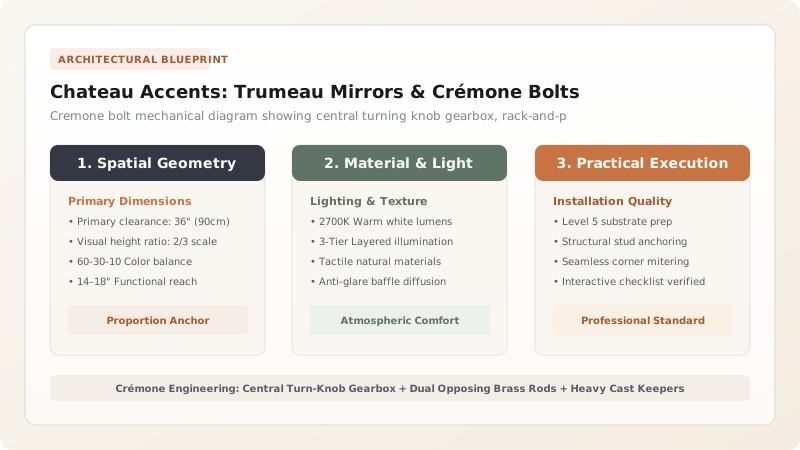
Turning the central brass knob drives Dual Solid Brass Rods simultaneously into top and bottom brass strike plates. Review boiserie paneling in boiserie wall paneling and explore French Chateau hub.
French Window & Door Hardware Comparison
Use this reference table to calculate exact physical dimensions, ratios, and specifications before purchasing:
| Hardware System | Material & Finish | Locking Mechanism | Historical Authenticity |
|---|---|---|---|
| Solid Cast Brass Crémone Bolt (Optimal) | Unlacquered Heavy Cast Brass | Top & bottom simultaneous rod bolt | 5 / 5 (100% Authentic 18th-Century French) |
| Traditional French Espagnolette | Hand-Forged Wrought Iron | Rotating vertical bar with hook cams | 5 / 5 (Historic countryside chateau) |
| Modern Multi-Point Concealed Lock | Stainless steel internal gears | Hidden edge latch pins | 2 / 5 (Modern utility / No surface visual elegance) |
| Standard Single-Point Turn Latch (Avoid) | Zinc die-cast | Center catch only | FAILS: Tall French doors bow and draft |
Tall Casement Door Rod Binding Constraints
Every successful decoration project must account for physical and environmental constraints:
Crémone Vertical Rods Binding and Jamming Due to Seasonal Door Sagging
Tall 9-foot solid wood French doors expand in summer, causing top and bottom crémone rod tips to bind against strike plates; lubricate rod guides with high-viscosity silicone grease and elongate the internal strike plate mortises by 1/4" to allow smooth seasonal operation.
How to Install a Trumeau Mirror and Fit Brass Crémone Bolts
Execute this professional sequence to achieve flawless results without backtracking:
Install Carved Marble Fireplace Mantel on Hearth
Anchor Louis XV carved Carrara marble mantel to masonry chimney breast using brass ties and plaster.
Frame Boiserie Trumeau Mirror Opening Directly Above Mantel
Construct solid wood boiserie framing flush with mantel width, extending vertically to crown cornice.
Mount Antique Distressed Mercury Mirror Glass into Frame
Set 1/4" antiqued mirror glass into frame rebate; cushion with neoprene setting blocks; nail wood stops.
Attach Carved Gilded Trumeau Crest (*Fronton*) Over Mirror
Pin hand-carved water-gilded ribbon-and-wreath rocaille crest to the upper boiserie panel above mirror.
Position Crémone Central Gearbox on French Casement Door
Center cast brass gearbox 38" above finished floor; pre-drill and fasten with solid brass slotted screws.
Cut Solid Brass Upper and Lower Locking Rods to Length
Measure from gearbox to top and bottom door headers; cut brass rods with metal saw; chamfer rod tips.
Install Rod Guide Brackets and Mortise Strike Keepers
Mount decorative guide brackets along door stile; mortise brass strike plates into header and floor threshold.
Common Mistakes & Countermeasures
Avoid these costly errors that compromise aesthetics, ergonomics, and budget:
Using Modern Shiny Lacquered Brass Hardware
Project Execution Checklist
Track your physical progress. Checkboxes persist automatically on this device:
Frequently Asked Questions
What is the difference between a crémone bolt and an espagnolette?
A *crémone bolt* operates by turning a knob that moves two vertical rods linearly up and down into top and bottom strike holes. An *espagnolette* operates with a swinging lever handle that rotates a continuous vertical rod with hook-shaped cams at the top and bottom.


