
Decorate with cushions effectively by using 90/10 feather-down inserts sized 2 inches larger than the cover, applying the 60-30-10 color rule across pillow fabrics, arranging cushions in a 2-1-1 symmetry, and executing the central karate chop crease.
At a Glance: Key Takeaways
- Insert Rule: Buy feather-down inserts 2 inches LARGER than covers for plump volume.
- Apply 60-30-10 color ratio: 60% neutral base pillows, 30% secondary color, 10% bold accent.
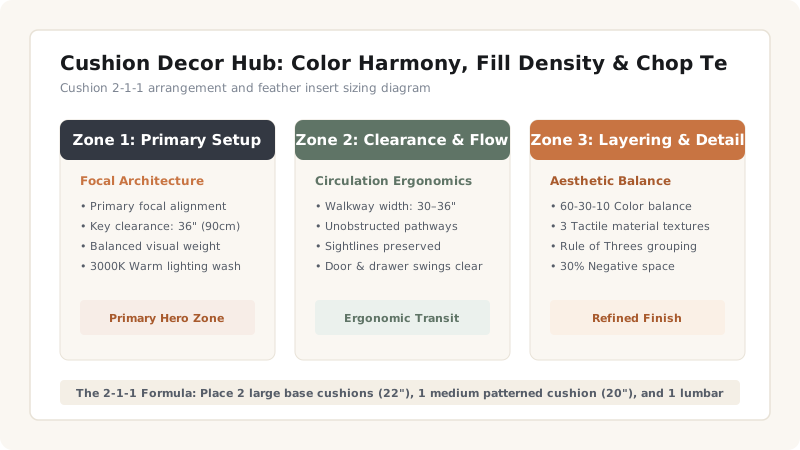
- The 2-1-1 Arrangement Formula: 2 outer 22" base cushions, 1 middle 20" patterned cushion, 1 lumbar.
- Feather-down inserts hold the classic karate chop center crease; polyfill inserts do not.
In-Depth Guides in this Directory
Explore specialized subtopic blueprints, technical dimensions, and execution checklists:
Cushion Colour Combinations: 60-30-10 Pillow Integration
Master cushion color combinations: 60-30-10 pillow palettes, mixing solids with patterns, sofa color matching, and seasonal textile swaps.
Cushion Arrangement Formulas: 2-1-1 Rule & Asymmetric Groupings
Master cushion arrangement formulas: 2-1-1 symmetry, asymmetric 3-pillow groupings, corner cascading, and sectional sofa pillow styling.
1. Cushion Styling Architecture & Spatial Proportion Rules
Decorative cushions and throw pillows represent the ultimate tactile and chromatic bridge in residential interior design. Operating at the exact intersection of ergonomic comfort and visual composition, cushions have the unique power to transform a neutral, rigid sofa or bed platform into an inviting, layered sanctuary. However, cushion styling is governed by precise architectural rules of proportion, scale, and textile physics: an arbitrary collection of mismatched pillows produces visual chaos, while an overly stiff, matching catalog set makes a living space feel sterile and uninviting.
Proportioning cushions relative to seating scale is the foundational principle. A common design failure is placing undersized 16x16 inch pillows onto deep 40-inch sectional sofas, where they appear like insignificant postage stamps, or conversely, cramming massive 24x24 inch Euro shams onto shallow 32-inch loveseats, leaving zero physical seating depth for guests. Observe these foundational scale formulas:
- Standard 84-to-96 Inch 3-Seater Sofa: Anchor the outer corners with generous 22x22 inch foundational cushions, layer inward with 20x20 inch accent cushions, and finish with a single centered 14x20 or 12x24 inch lumbar cushion (the classic 2-2-1 arrangement).
- Deep Sectional Lounge (38-44" depth): Anchor each corner and chaise lounge terminal with oversized 24x24 inch pillows, stepped down to 22x22 and 20x20 inches to support relaxed, reclining postures.
- Accent Armchairs: Dress single armchairs with a single dedicated accent: either a tailored 18x18 or 20x20 inch square pillow or a structured 12x20 inch lumbar pillow that supports the lower spinal curve without pushing the occupant forward.
Always preserve at least 18 to 22 inches of unobstructed seat depth in front of cushions so occupants can sit comfortably without tossing pillows onto the floor.
2. Insert Engineering: The 2-Inch Upsizing Rule & Fill Materials
The interior fill material dictates 90% of a cushion's aesthetic dignity, tactile weight, and longevity. A high-end linen or velvet cushion cover stuffed with a cheap polyester fiberfill insert appears limp, lumpy, and hollow, flattening into a lifeless pancake within weeks of daily use.
The golden rule of professional cushion styling is the 2-Inch Insert Upsizing Rule: always specify an insert that is exactly two inches larger than the decorative cover. For example, a 20x20 inch cushion cover requires a 22x22 inch insert; a 22x22 inch cover requires a 24x24 inch insert. The additional fill volume completely packs out the interior corners of the cover, creating plump, tailored edges and eliminating unsightly loose, drooping fabric ears.
Fill materials should be specified according to tactile and maintenance requirements:
- 90/10 or 95/5 Feather & Down Blend (The Luxury Gold Standard): Composed of 90% small grey duck or goose feathers (which provide structural resilience and bounce) and 10% pure down clusters (which provide cloud-like softness). Down-blend cushions hold a crisp shape, feel luxuriously malleable, and can be fluffed repeatedly for decades. Ensure the insert shell features a 100% down-proof 240+ thread count cotton cambric weave to prevent sharp feather quills from poking through.
- Down-Alternative Micro-Denier Fiber: For allergy-sensitive households or vegan preferences, siliconized micro-denier poly-gel fibers mimic the density, weight, and malleable chop of natural down without causing allergic reactions or requiring animal products.
- High-Resilience Polyfill: Inexpensive but rigid and bouncy; best reserved for outdoor patio cushions where moisture resistance is critical, but avoided for luxury indoor living spaces.
3. The 3-Tier Pattern Mixing Formula & Textile Layering
Creating a visually rich, curated cushion landscape requires balancing diverse textile weaves and pattern scales without visual clash. Cohesive styling relies on the architectural three-tier pattern formula:
- Tier 1: The Large-Scale Anchor: A dominant, large-format pattern (such as an oversized floral botanical, a broad windowpane grid, or an abstract geometric weave) that introduces the foundational color palette of the room.
- Tier 2: The Small-Scale Geometric / Organic: A secondary pattern scaled at least 50% smaller than the primary anchor (such as a classic ticking stripe, small herringbone, houndstooth, or micro-ditsy print). The contrast in pattern scale prevents visual competition.
- Tier 3: The Rich Solid Texture: A solid-colored cushion featuring deep tactile character rather than flat print: heavyweight washed Belgian linen, ribbed cotton corduroy, curly wool bouclé, or matte mohair velvet. The solid texture grounds the composition and allows the eyes to rest.
Unify diverse patterns through a shared anchor tone: ensure every cushion shares at least one common color note (such as warm cognac, charcoal, or olive green) to tie the arrangement into a harmonious whole.
4. Zipper Construction, Fluffing Protocols & Cleaning Care
High-quality cushion covers are engineered for effortless maintenance and longevity. Always look for concealed hidden nylon coil zippers (YKK brand preferred) tucked neatly beneath an understated fabric flap along the bottom seam. Avoid exposed industrial metal zippers that scratch delicate leather upholstery or snag knit throws.
Establish a daily fluffing protocol: grasp the cushion on opposite sides, punch the edges inward simultaneously to redistribute down clusters, and drop it lightly onto the sofa cushion. For a relaxed, lived-in designer look, give the center top edge a gentle karate chop to create a soft, welcoming center crease. Wash natural linen covers in cold water on gentle cycle and line-dry in the shade; dry-clean delicate silks, velvets, and wool tweeds annually to preserve fiber loft and prevent dimensional shrinkage.
Cushion Dimensions, Inserts & Seating Arrangement Matrix
Use this reference table to calculate exact physical dimensions, ratios, and specifications before purchasing:
| Seating Type | Cushion Arrangement | Cover Dimensions | Required Insert Size | Ideal Fabric Combination |
|---|---|---|---|---|
| Classic 3-Seater Sofa | 2-2-1 Symmetrical layout | 2x 22", 2x 20", 1x 14x22" | 2x 24", 2x 22", 1x 16x24" | Washed linen + ticking stripe + velvet lumbar |
| Deep L-Shape Sectional | Corner clusters (3-2-2) | 4x 24", 3x 22", 2x 20" | 4x 26", 3x 24", 2x 22" | Chunky bouclé + geometric jacquard + washed canvas |
| Single Accent Armchair | Single tailored accent | 1x 20x20" or 1x 12x20" | 1x 22x22" or 1x 14x22" | Textured wool tweed or cognac leather piped linen |
| King / Queen Bed Platform | Tri-tier hotel layering | 3x 26" Euro, 2x 20", 1x bolster | 3x 28" Euro, 2x 22", custom bolster | Crushed velvet Euro shams + slub linen pillows |
Cushion Styling Constraints
Every successful decoration project must account for physical and environmental constraints:
Pet Hair & Claw Snagging on Loose Weaves
Open loop bouclé and delicate silk cushions snag easily on cat and dog claws; specify tightly woven performance velvets or smooth heavy canvas in homes with active pets.
Feather Quill Leakage from Cheap Inserts
Low-quality down inserts shed sharp quills through fabric covers, poking occupants; always verify that inserts use down-proof 100% cotton cambric ticking shells with double-stitched piped edges.
Loss of Seating Space on Narrow Sofas
Piling six large cushions onto a shallow sofa leaves no room for humans to sit, forcing guests to awkwardly relocate cushions to the floor; restrict cushions to maximum 3 to 4 pieces on sofas with under 34 inches of total depth.
How to Style Cushions on a Sofa
Execute this professional sequence to achieve flawless results without backtracking:
Insert 24-Inch Feather Pads
Stuff 24x24 inch feather inserts into two 22x22 inch solid linen covers.
Place Corner Anchors
Position 22-inch cushions in left and right sofa corners.
Layer 20-Inch Patterned Pillows
Layer 20-inch patterned velvet pillows directly in front.
Karate Chop Tops
Strike the top center of each cushion with the side of your hand to create a central crease.
Common Mistakes & Countermeasures
Avoid these costly errors that compromise aesthetics, ergonomics, and budget:
Matching Cushion Fabric Exactly to Sofa Upholstery
Using Sized-to-Fit Inserts Instead of Upsizing
Over-Aggressive Rigid Karate Chopping
Project Execution Checklist
Track your physical progress. Checkboxes persist automatically on this device:
Frequently Asked Questions
Why should cushion inserts be 2 inches larger than the cover?
Upsizing the insert by 2 inches (e.g., using a 22x22 inch insert for a 20x20 inch cover) ensures the fill completely packs out the corners and seam allowances. This prevents drooping fabric ears, eliminates hollow spots, and produces a plump, tailored, designer look.
What is the best cushion fill: feather down or polyester fiberfill?
A 90/10 or 95/5 feather-and-down blend is the gold standard for luxury indoor seating. Feathers provide structural resilience while down provides cloud-like softness, holding an organic shape and lasting for decades. Polyester fiberfill is springy and inexpensive but flattens quickly into lumps and cannot be fluffed effectively.
What is the 2-2-1 cushion arrangement formula?
The 2-2-1 rule is the classic styling arrangement for a standard three-seater sofa: place two large 22x22 inch foundational cushions in the outer corners, layer two 20x20 inch medium accent cushions slightly in front, and finish with a single 14x20 or 12x24 inch lumbar cushion centered on the sofa.
How do you mix different cushion patterns without clashing?
Follow the three-tier rule: pair one large-scale print (like a bold floral or botanical), one small-scale pattern (like a narrow stripe or micro-check), and one solid textured fabric (like velvet, bouclé, or washed linen). Ensure all three cushions share at least one common coordinating accent color.
How often should decorative cushion covers be washed?
Wash or dry-clean removable cushion covers every three to six months for everyday living room sofas, or immediately when spot spills occur. Always inspect the care label: natural linen can typically be machine-washed in cold water and air-dried, while wool, velvet, and silk require professional dry cleaning.

