
Prevent Corten steel rust runoff from staining light-colored stone pavers and concrete by setting edging and planters in a 4-inch deep crushed gravel drip trench (such as dark basalt or granite chips) that absorbs early runoff. Pre-oxidize the steel before installation, drill 3/4" weep holes wrapped in geotextile in planter bottoms, and clean accidental stains with a 5% oxalic acid solution.
At a Glance: Key Takeaways
- The 6-Month Rust Runoff Phase: Unbound ferrous ions leach during initial rains before the dense goethite patina locks solid.
- 4-Inch Crushed Basalt Drip Trench: Captures dripping rust water directly below planters, isolating iron stains from light pavers.
- Pre-Weathering & Washing Protocol: Accelerating and power-washing the steel in a staging yard removes 95% of loose rust before jobsite install.
- Planter Bottom Weep Holes (3/4" / 20mm): Prevents waterlogged planter soil from turning anaerobic and rotting plant root balls.
- Oxalic Acid Stain Removal (5% Concentration): Safely dissolves stubborn orange iron oxide stains from concrete and travertine without etching stone.
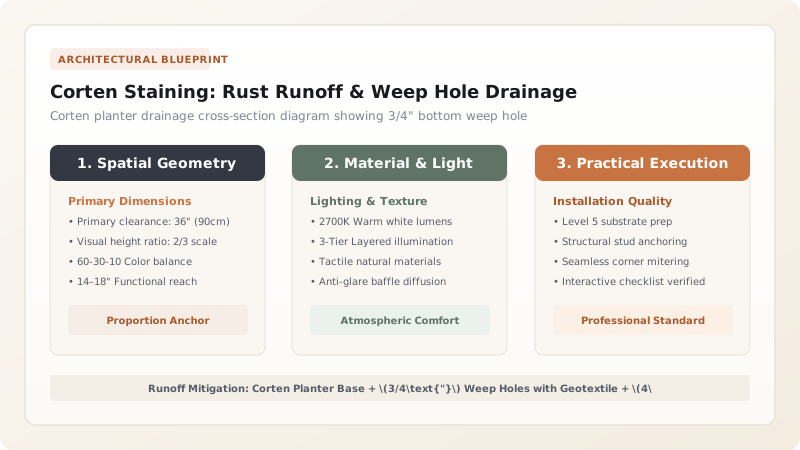
1. Chemical Hydrology: Ferrous Ion Runoff & Concrete Paver Staining
During the first 6 months of outdoor weathering, raw Corten steel releases soluble Ferrous Ions (\(\text{Fe}^{2+}\)) in rainwater runoff. If this water washes across porous concrete pavers or limestone tiles, the iron oxidizes into permanent orange rust stains.
Landscape architects prevent staining by never setting Corten steel directly on light-colored paving. Always create a 4-inch Wide Crushed Basalt or Mexican Beach Pebble Drip Trench beneath all steel edges to capture runoff. Learn patina acceleration in atmospheric weathering patina chemistry.

2. Planter Weep Hole Engineering & Oxalic Acid Stain Removal
Custom Corten planters require 3/4" (20mm) Bottom Drainage Weep Holes Spaced Every 12 Inches, covered with Non-Woven Geotextile and 2 Inches of Clean Crushed Gravel to prevent soil loss.
If accidental rust staining occurs on concrete, dissolve 1 cup of Oxalic Acid Crystals in 1 gallon of warm water (5% solution), scrub with a nylon brush, let sit for 10 minutes, and rinse with water. Review stake welding in heavy-gauge steel anchoring stakes and explore Corten steel hub.
Rust Runoff Mitigation Strategies Comparison
Use this reference table to calculate exact physical dimensions, ratios, and specifications before purchasing:
| Runoff Mitigation Strategy | Stain Prevention Effectiveness | Labor & Material Cost | Best Landscape Application |
|---|---|---|---|
| Crushed Dark Gravel Drip Trench (Optimal) | 100% Effective (Isolates runoff) | Low (Clean gravel channel) | Adjacent to Light Travertine / Pavers |
| Pre-Weathering & Power-Washing offsite | 90% Effective (Removes loose rust) | Moderate (Staging yard protocol) | Pre-fabricated Planters & Sculptures |
| Polyurethane Clear Sealer Topcoat | 80% Effective (Temporary barrier) | Moderate (Requires re-application every 2 yrs) | Indoor/Outdoor Transition Planters |
| Direct Installation on Pavers (Avoid) | 0% FAILS: Severe orange stains | Zero initially (Expensive cleaning later) | Never install un-isolated Corten on pavers |
Planter Soil Weep Hole Sludge Clogging Constraints
Every successful decoration project must account for physical and environmental constraints:
Potting Soil Washing Directly into Weep Holes Clogging Drainage and Rotting Tree Roots
Fine potting soil washes into bottom weep holes, forming a dense anaerobic mud plug that drowns plant roots; place a layer of Class 1 non-woven geotextile fabric and 2 inches of clean 3/4" drainage gravel across the entire planter bottom before adding planting soil.
How to Detail Corten Drainage and Clean Accidental Rust Stains
Execute this professional sequence to achieve flawless results without backtracking:
Drill 3/4" Drainage Weep Holes in Planter Floor
Drill 3/4" (20mm) holes every 12" on center in the bottom plate of the Corten steel planter.
Line Planter Floor with Geotextile and 2" Drainage Stone
Place non-woven geotextile filter fabric over holes; add 2" of clean 3/4" crushed stone to ensure free drainage.
Excavate 4" Wide Gravel Drip Channel Around Planter Base
Cut 4" wide × 4" deep channel in surrounding paving; fill with dark crushed basalt or river pebbles.
Elevate Planter Base on 1/2" Rubber Neoprene Feet
Set planter on 1/2" thick heavy rubber leveling pads to allow free water airflow beneath the floor plate.
Mix 5% Oxalic Acid Rust Stain Cleaning Solution
Dissolve 8 oz oxalic acid powder (wood bleach) in 1 gallon warm water in plastic bucket.
Scrub Stained Concrete Pavers with Stiff Nylon Brush
Apply oxalic acid solution to accidental orange stains; scrub vigorously; let dwell 10 to 15 minutes.
Rinse Pavement Thoroughly with Clean Water
Flush area with garden hose; stubborn stains disappear as iron oxalate rinses away with zero acid etching.
Common Mistakes & Countermeasures
Avoid these costly errors that compromise aesthetics, ergonomics, and budget:
Using Chlorine Bleach to Clean Rust Stains from Pavers
Project Execution Checklist
Track your physical progress. Checkboxes persist automatically on this device:
Frequently Asked Questions
Will Corten steel ever stop producing rust runoff?
Yes! After 12 to 18 months of outdoor exposure, the amorphous iron oxide stabilizes into a hard crystalline goethite layer. Once mature, rust runoff drops to near zero, and the steel feels dry and smooth to the touch.


