Classical Roman opus sectile ('cut work') is an elite form of architectural stone marquetry that reached its apex during the Imperial era and Late Antiquity (first to fourth centuries CE) in monuments such as Hadrian's Villa at Tivoli, the Basilica Junius Bassus, and the Pantheon. Unlike tessellated mosaics composed of thousands of tiny uniform cubes (opus tessellatum), opus sectile utilizes large, individually shaped, thin-cut stone plaques (crustae or sectilia) cut to exact geometric or figurative silhouettes. Masons selected rare, highly prized polychrome stones quarried across the Mediterranean: imperial red porphyry from Egypt, green serpentinite (Lapis Lacedaemonius) from Sparta, golden-yellow Giallo Antico from Numidia, and peacock-veined Pavonazzetto from Phrygia. Sliced into 8 to 15 mm slabs using toothless iron saws and abrasive emery sand, these stone pieces were set with hairline joints in hydraulic pozzolanic lime-cocciopesto bedding mortars, creating indestructible, richly colored geometric floor pavements and figurative wall revetments.
At a Glance: Key Takeaways
- Historical Era: Imperial Rome to Late Byzantine (1st c. BCE – 6th c. CE)
- Primary Imperial Stones: Red Porphyry, Lapis Lacedaemonius, Giallo Antico, Pavonazzetto
- Slab Thickness (Crustae): 8 to 15 mm thin-cut polished stone plaques
- Sawing Medium: Toothless iron wire/blades with Naxos emery or quartz sand abrasive
- Bedding Mortar: Hydraulic pozzolanic lime + crushed terracotta (cocciopesto)
- Key Monuments: Pantheon (Rome), Hadrian's Villa (Tivoli), Ostia Antica, Ravenna
In-Depth Guides in this Directory
Explore specialized subtopic blueprints, technical dimensions, and execution checklists:
Imperial Stone Slicing & Petrology: Red Porphyry, Giallo Antico, Serpentinite, and Emery Wire Saws
In-depth study of Roman lapidary engineering: toothless iron frame saws, Naxos emery abrasives, Mohs hardness differentials, and thin-slicing imperial porphyry.
Hydraulic Pozzolanic Bedding Mortars: Slaked Lime Formulations, Crushed Terracotta (Cocciopesto), and Hairline Joints
Master Roman hydraulic bedding chemistry: slaked lime putty, volcanic pozzolana ash, cocciopesto terracotta flour, and hairline joint bedding for opus sectile.
Geometric Sectilia Patterns and Wall Crustae Conservation: Hexagons, Triangles, Desalination, and In Situ Consolidation
Advanced guide to geometric tessellations and conservation science for Roman opus sectile: hexagonal grids, wall revetment cramps, desalination, and lime grouting.
Imperial Stone Prestige & The Geology of Mediterranean Quarries
In Roman architectural philosophy, polychrome marble was a visible declaration of imperial hegemony. While standard public buildings utilized white Carrara (Luna) marble, the private villas of emperors and the floors of imperial basilicas displayed an extraordinary spectrum of stones transported thousands of miles across the Mediterranean under the direct control of the imperial quarry administration (cura marmorum).
Among the most coveted was Porfido Rosso Antico (Imperial Red Porphyry), an ultra-dense volcanic andesite quarried in the remote Eastern Desert of Egypt at Mons Porphyrites. Its deep imperial purple hue was reserved exclusively for the emperor. From Sparta in Greece came Porfido Verde Antico (Lapis Lacedaemonius), a brilliant dark-green serpentinite studded with pale crystals. Northern Africa supplied Giallo Antico (Marmor Numidicum from modern Tunisia), a radiant golden-yellow limestone with vivid crimson breccia veins, while Asia Minor provided Pavonazzetto (Marmor Phrygium), white crystalline marble heavily veined in rich violet. Because these stones were exceedingly hard, costly, and limited in block size, Roman lapidaries developed thin-slicing techniques to maximize surface coverage, inventing the art of opus sectile.
Lapidary Mechanics: Wire Sawing, Emery Powders, & Bevel Joints
The fabrication of stone crustae (thin plaques) was an exercise in patient lapidary physics. Roman stonecutters (marmorarii) lacked diamond saws. Instead, they mounted long toothless iron blades or bronze tensioned wires into wooden frame saws (serrae lapidariae).
The cutting action was performed not by the metal, but by abrasive slurry continually poured into the kerf: water blended with crushed volcanic pumice or ultra-hard corundum emery powder imported from the Greek island of Naxos. Guided by string lines, the saw sliced massive boulders into wafers just 8 to 12 mm thick with astonishing parallelism. Once sliced, each geometric piece—square, triangle, hexagon, or curved roundel (rota)—was shaped using iron rasp files and bronze grinding laps charged with fine emery flour. The edges were shaped with a slight inward back-bevel of 2 to 3 degrees. This subtle taper allowed the top surface edges of adjoining stones to butt together into a virtually invisible hairline joint (<0.5 mm), while leaving a wider gap underneath for mortar penetration.
Vitruvian Stratigraphy & Hydraulic Cocciopesto Mortars
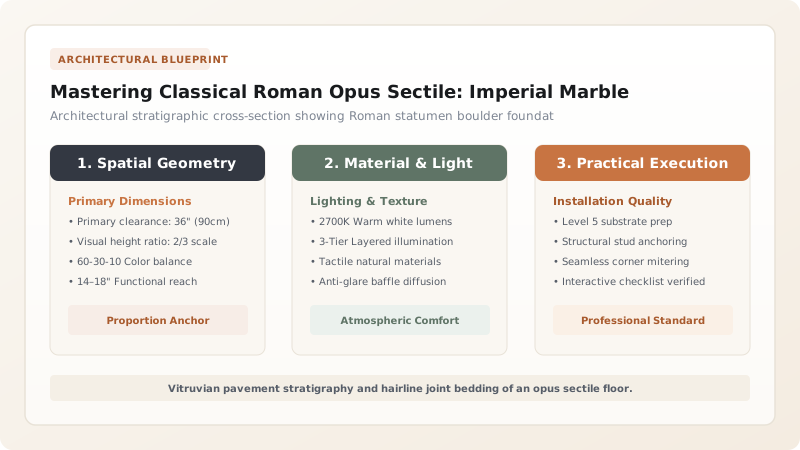
A rigid, non-settling sub-base was critical to prevent cracked crustae under foot traffic. In his treatise De Architectura, Roman architect Vitruvius outlined the mandatory four-layer flooring stratigraphy.
The foundation began with the statumen: a 200 mm layer of dry fist-sized volcanic basalt boulders rammed into subsoil. Over this rested the rudus: a 150 mm thick concrete bed of lime and coarse broken stones (ratio 1:3). Above lay the nucleus: a 50 mm hydraulic mortar bed made from non-hydraulic slaked lime putty blended with finely ground volcanic pozzolana ash from the Bay of Naples and crushed terracotta tile flour (cocciopesto). The pozzolana and calcined clay reacted with lime to form a waterproof, fast-setting calcium silicate hydrate matrix. While the nucleus was still damp and plastic, the stonecutters spread a thin buttery slurry of pure slaked lime and fine marble dust, gently tapping the crustae into place with wooden blocks to achieve a glass-flat horizontal plane.
Geometric Tessellations & Figurative Opus Sectile
Opus sectile designs fall into two distinct master traditions: architectural geometric pavements and figurative wall panels. Geometric pavements utilized mathematical tessellations: repeating grids of four-pointed stars framed in porphyry bands, interlacing octagons, and massive central porphyry roundels (rotae) sliced from imperial columns.
On imperial walls, the technique attained the nuance of oil painting executed in stone. Master lapidaries cut complex figurative scenes—such as the celebrated 4th-century panels from the Basilica of Junius Bassus on the Esquiline Hill, depicting the consul riding a triumphal chariot—by selecting stone pieces whose natural veins, clouding, and variegation simulated muscle contours, drapery folds, and sky gradients. The finished assemblies were polished using progressively finer grades of pumice stone, tripoli earth, and natural beeswax, reflecting palace candlelight with a rich, satiny luster that never faded under sunlight.
Imperial Roman Decorative Stone Varieties in Opus Sectile
Use this reference table to calculate exact physical dimensions, ratios, and specifications before purchasing:
| Stone Variety | Latin / Trade Name | Geological Type | Origin / Quarry Site | Dominant Color & Veining |
|---|---|---|---|---|
| Imperial Red Porphyry | Porfido Rosso Antico | Volcanic andesite / dacite | Mons Porphyrites (Egypt) | Deep purple-red with white feldspar crystals |
| Spartan Green Porphyry | Lapis Lacedaemonius | Basaltic andesite serpentinite | Krokeai, Peloponnese (Greece) | Vibrant olive green with pale green laths |
| Numidian Yellow | Giallo Antico (Marmor Numidicum) | Bioclastic microcrystalline limestone | Simitthus / Chemtou (Tunisia) | Canary yellow to deep gold with red breccia |
| Phrygian Purple Marble | Pavonazzetto (Marmor Phrygium) | Metamorphic saccharoidal marble | Docimium / Iscehisar (Turkey) | Translucent white with intense violet veins |
| Carystian Green CIP | Cipollino (Marmor Carystium) | Metamorphic calc-schist | Carystus, Euboea (Greece) | Onion-skin wavy white and green ribbons |
Practical Constraints
Every successful decoration project must account for physical and environmental constraints:
Extreme Scarcity and Protection of Ancient Mediterranean Stone Quarries
The original Roman imperial quarries (such as Mons Porphyrites) have been exhausted or protected as UNESCO archaeological zones for centuries. Mitigation: Conservators reclaim historic fragments from salvage deposits (spolia) or source modern petrologically compatible stones (e.g., Swedish porphyry or Greek serpentinite).
Differential Hardness Between Interlocking Polychrome Stones
Porphyry has a Mohs hardness of 7, while adjacent Giallo Antico limestone has a hardness of only 3; polishing them together causes the softer stone to hollow out. Mitigation: Utilize wide, flat cast-iron lapping blocks that span multiple stones simultaneously, preventing abrasive pads from dipping into softer marble pockets.
Execution Blueprint & Craftsmanship Sequence
Execute this professional sequence to achieve flawless results without backtracking:
Laying the Vitruvian Stone Foundation
Excavate subsoil and compact a 200 mm layer of fist-sized dry basalt boulders (statumen). Pour a 150 mm lime-gravel concrete bed (rudus) and tamp firmly until dense.
Mixing Slaked Lime, Pozzolana, and Brick Dust
Pug 1 part mature slaked lime putty with 1 part volcanic pozzolana ash and 1 part finely crushed terracotta pottery flour (cocciopesto). Spread a 50 mm bedding layer.
Slicing 10 mm Crustae Slabs with Emery
Mount iron blades in a wooden frame saw. Flood the cutting kerf continuously with Naxos emery abrasive powder and water, slowly slicing dense stone blocks into 10 mm wafers.
Grinding 2-Degree Inward Edge Bevels
Grind geometric shapes on flat iron laps using wet carborundum or emery flour. File an inward 2-degree taper on all bottom edges to enable seamless hairline top joints.
Bedding Plaques with Hairline Seams
Brush a buttery slurry of pure slaked lime and marble dust over the plastic nucleus mortar. Press stone crustae into position, tapping lightly with a wooden block to align heights.
Polishing Surface with Pumice and Beeswax
Allow mortar to cure for 28 days. Hone the entire floor with flat pumice stones and water to eliminate lippage. Burnish with molten beeswax and linen cloths for a satiny sheen.
Common Mistakes & Countermeasures
Avoid these costly errors that compromise aesthetics, ergonomics, and budget:
Setting Dense Porphyry Crustae in Fast-Setting Rigid Portland Cement
Leaving Perpendicular 90-Degree Cut Edges on Crustae
Grinding the Floor Dry with High-Speed Angle Grinders
Acid-Washing Opus Sectile Floors with Muriatic Acid
Project Execution Checklist
Track your physical progress. Checkboxes persist automatically on this device:
Frequently Asked Questions
What is the primary difference between opus sectile and mosaic (opus tessellatum)?
Opus tessellatum is composed of thousands of small, roughly cubic tesserae (typically 5 to 15 mm cubes) laid in grid patterns to create images through pointillism. Opus sectile uses much larger, precision-cut stone plaques (crustae) shaped to match the exact geometric contours of the design, resulting in sleek, unbroken planes of color and natural geological veining.
Why did Roman builders add crushed pottery (cocciopesto) to their mortar?
Crushed terracotta contains calcined aluminosilicates that react chemically with calcium hydroxide in slaked lime. This pozzolanic reaction produces insoluble calcium silicate and aluminate hydrates, allowing the mortar to set hydraulically in thick layers beneath impermeable stone slabs without requiring atmospheric carbon dioxide.
Can historic opus sectile pavements be conserved in situ?
Yes. Conservators stabilize loose crustae by injecting ultra-fine hydraulic lime micro-grouts beneath hollow sections, extracting destructive soluble ground salts with deionized water cellulose poultices, and consolidating friable stones with solvent-borne ethyl silicate.