
Casting monumental sculptures in Coade stone—such as the 13-ton Westminster Bridge South Bank Lion—demanded rigorous shrinkage compensation and piece-mold engineering. Sculptors scaled original plaster models exactly 8.33% larger (13 inches to the foot) to offset drying and kiln shrinkage. Complex figures were divided into interlocking hollow segments pressed in plaster piece-molds, reinforced with internal ceramic diaphragms, and joined post-fire with lead and iron dowels.
At a Glance: Key Takeaways
- Shrinkage Rate: Precisely 8.33% linear shrinkage (1/12th scale increase on master models)
- Molding Method: Multi-piece interlocking gypsum plaster piece-molds (20–60 pieces per statue)
- Clay Installation: Manual plastic bat hand-pressing (50–75mm uniform shell thickness)
- Internal Core: Hollow chambers with perforated ceramic honeycomb diaphragms for steam escape
- Post-Fire Assembly: Interlocking tongue-and-groove joints locked with molten lead and bronze cramps
- Master Sculptors: John Bacon RA, John Flaxman RA, Benjamin West PRA
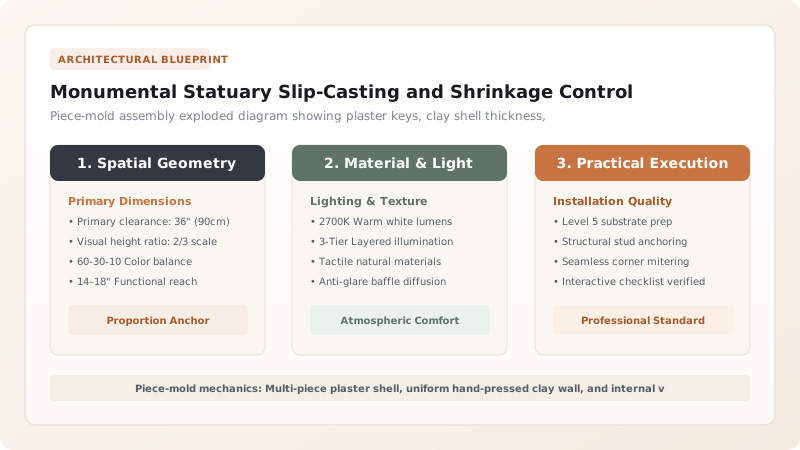
Piece-Mold Engineering and Undercut Release
In classical sculpture, human anatomy, billowing drapery, and curling lions' manes create deep undercuts that make single-piece molding impossible. Eleanor Coade's Lambeth manufactory perfected the craft of multi-part plaster piece-molding:
- Master Model Sculpting: The sculptor sculpted a master archetype in clay or plaster. Because all elements shrank during drying and firing, the sculptor worked using a specialized 'shrinkage rule'—scaled 13 inches to the foot (108.33% of final required dimension).
- Segmental Plaster Pieces: Plaster of Paris was applied in small, interlocking tapered blocks over every undercut section. Each block featured hemispherical registration notches ('keys').
- Outer Mother Mold: A heavy two-piece plaster jacket (the mother mold or case) enclosed all the internal pieces, holding them in perfect registration under the immense pressure of hand clay wedging.
Hollow Ceramic Armature and Internal Venting Systems
A solid clay sculpture of monumental size would inevitably explode inside the kiln as trapped water turns to superheated steam. Coade statues were pressed as hollow shells with a uniform wall thickness of 50 to 75 mm:
Craftsmen hand-pressed pre-rolled clay slabs into the mold cavities. Across large structural voids (such as the body of the South Bank Lion), internal ceramic web walls (diaphragms) were built by hand. These webs featured 50mm circular perforations, creating an interconnected internal honeycomb. This design allowed kiln heat to circulate inside the statue while providing structural rigidity that prevented the hollow figure from slumping under its own weight while red-hot.
Monumental Statuary Slip-Casting and Shrinkage Control in Coade Terracotta Architectural Decision Matrix
Use this reference table to calculate exact physical dimensions, ratios, and specifications before purchasing:
| Statue Component | Mold Type | Casting Technique | Wall Thickness | Jointing Method |
|---|---|---|---|---|
| Torso / Main Body | Multi-piece plaster with outer case | Hand-pressed plastic clay bats | 60–75 mm hollow | Internal ceramic gussets & lead dowels |
| Limbs & Outstretched Arms | Two-part split plaster mold | Hollow core with central void | 40–50 mm hollow | Internal bronze tie-rods & lead bedding |
| Fine Drapery & Hair | Flexible sulfur / small plaster wedges | Direct mold relief & hand undercutting | Solid or semi-solid | Monolithic integral with body |
| Plinth / Pedestal Base | Four-piece open box mold | Heavy hand pressing with bottom lip | 75–100 mm | Mortar bed with copper anchor bolts |
Practical Constraints
Every successful decoration project must account for physical and environmental constraints:
Kiln Chamber Dimensions
Plaster Mold Deterioration
Molding, Pressing, and Assembling a Coade Architectural Figure
Execute this professional sequence to achieve flawless results without backtracking:
Shrinkage-Scaled Modeling
Sculpt the master model 8.33% oversize using a dedicated Coade proportional caliper to compensate for kiln shrinkage.
Piece-Mold Assembly
Cast plaster piece-molds over all undercut details; encase in a two-part outer plaster mother mold jacket.
Hand-Wedging Clay Bats
Roll clay into 60mm-thick bats; press firmly into mold crevices with fingertips and wooden beaters, cross-hatching seams.
Internal Diaphragm Installation
Construct hollow internal clay honeycomb ribs with vent holes to support the hollow shell during firing.
Case Removal & Chasing
Strip outer jacket and individual plaster pieces; carve away seam flashings and undercut drapery with steel modeling loops.
Kiln Stacking & Firing
Support hollow extremities on ceramic props inside the muffle kiln; fire to 1,120°C for 96 hours.
On-Site Cramp Pinning
Assemble fired sections onto the building facade using concealed phosphor-bronze cramps set in molten lead.
Common Mistakes & Countermeasures
Avoid these costly errors that compromise aesthetics, ergonomics, and budget:
Failing to perforate internal ceramic web diaphragms
Non-uniform shell wall thickness
Joining multi-part fired sections with iron dowels
Project Execution Checklist
Track your physical progress. Checkboxes persist automatically on this device:
Frequently Asked Questions
How heavy was the South Bank Lion and how was it cast?
The South Bank Lion weighs approximately 13 tons and measures 3.7 meters in length. It was cast in separate modular hollow sections in 1837 and assembled around an internal structural iron armature pinned with lead at the Red Lion Brewery before being relocated to Westminster Bridge.
Why didn't Eleanor Coade use liquid slip-casting like modern sanitaryware?
Liquid slip contains excessive water (over 30%), resulting in massive shrinkage (up to 18–20%) that causes extreme warping in thick architectural pieces. Hand-pressing plastic clay containing 18% moisture and high grog content restricted shrinkage to a predictable 8.33%.


