
Design event backdrops by erecting a heavy-duty 8-12 foot pipe-and-drape frame anchored with 40-50lb base weights, layering opaque base drapes with sheer chiffon or 3D flower mats, and illuminating with indirect 2700K uplighting.
At a Glance: Key Takeaways
- Backdrops serve as the primary photo background for weddings, baby showers, and corporate events.
- Always anchor free-standing backdrop frames with 40-50lb counterweights to prevent tipping.
- Layering opaque background drapes under sheer chiffon adds rich photographic depth.
- Ensure 5 feet of clear floor space in front of backdrops for group photography.
In-Depth Guides in this Directory
Explore specialized subtopic blueprints, technical dimensions, and execution checklists:
Fabric & Drapery Backdrops: Chiffon, Velvet & Satin Layering Rules
Rig fabric drapery backdrops: chiffon, velvet, satin, pipe-and-drape rod pockets, swagging formulas, and LED backlighting.
Floral Backdrop Walls: Fresh & Faux Blossom Density & Frames
Build floral backdrop walls: 3D flower mat density, hydrangeas, roses, faux vs fresh flower mixes, grid wall mounting, and lighting.
DIY Backdrop Construction: Lightweight PVC, Wood Frame & Panels
Build DIY event backdrops: lightweight PVC pipe frames, timber wood panels, hanging paper flower displays, balloon strips, and budget setups.
1. Backdrop Structural Engineering & Photographic Optics
An event backdrop is a high-performance architectural installation engineered at the intersection of structural rigging, optical framing, and photographic physics. Whether serving as a wedding ceremonial altar, an executive corporate presentation stage, or an editorial photo-booth focal point, a backdrop defines the visual identity of an event. In an era dominated by high-resolution digital photography and immediate social media broadcast, every dimensional proportion, material reflectance index, and structural connection must be calibrated with engineering precision.
Photographic optics fundamentally dictate backdrop dimensions. A standard portrait lens (50mm to 85mm focal length on a full-frame sensor) captures subjects alongside a wide field of background perspective. Backdrops measuring under 8 feet wide inevitably suffer edge-bleed: photographer framing captures ugly hotel exit signs, fire sprinklers, or rigging stands at the periphery of group photos. To guarantee complete photographic immersion for groups of four to six individuals standing side-by-side, adhere to strict dimensional minimums:
- Solo / Couple Portrait Backdrop: Minimum 8 feet wide by 8 feet tall (2.4m x 2.4m).
- Standard Group Photo Backdrop (4-8 people): Minimum 10 to 12 feet wide by 8 to 10 feet tall (3.0m - 3.6m x 2.4m - 3.0m).
- Grand Wedding Stage Altar / Executive Step-and-Repeat: 16 to 24 feet wide by 10 to 12 feet tall (4.8m - 7.3m x 3.0m - 3.6m).
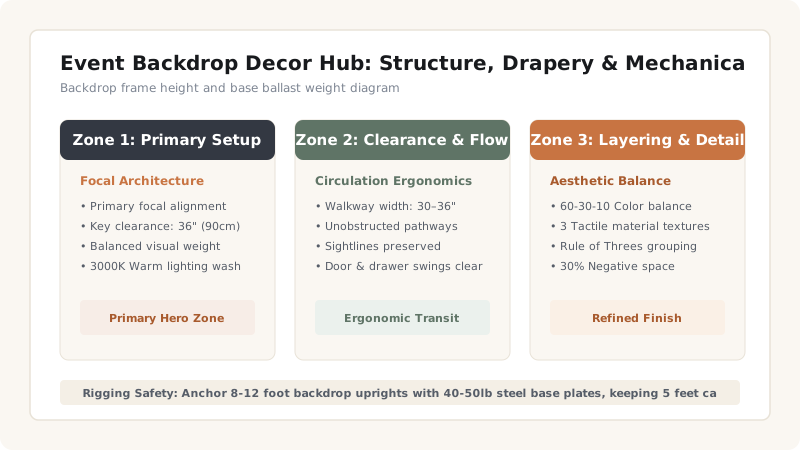
Maintain at least 36 to 48 inches of floor clearance between the backdrop plane and the standing subject. Positioning subjects at least 4 feet forward from the wall allows studio key lights to illuminate the subject without casting harsh, dark silhouettes onto the backdrop, while enabling portrait lenses to soften the background into smooth, flattering bokeh.
2. Rigging Hardware, Pipe-and-Drape Systems & Ballast Safety
Structural failure of a freestanding backdrop poses grave legal liability and catastrophic safety hazards. Crowded event environments experience constant air currents from HVAC blowers, passing guest collisions, and accidental pulling. A properly rigged backdrop must resist overturning moments without relying on tape or wall tacks.
Standard professional rigging relies on telescoping aluminum pipe-and-drape hardware featuring heavy cast-iron baseplates (weighing 15 to 30 lbs each) fitted with solid steel pin upright inserts. For freestanding installations over 8 feet tall or any frame supporting floral arrangements exceeding 20 lbs, mandatory ballast anchoring must be deployed: stack a minimum of two 20-lb rubber-coated cast iron weight horseshoes or dense canvas sandbags over each baseplate. When utilizing circular or geometric steel arch frames, clamp structural counterweights onto the rear horizontal crossbars concealed beneath fabric wraps or floral skirting.
For outdoor venues, wind loading increases exponentially: even a gentle 10 mph breeze exerts over 100 lbs of lateral shear force against an 8x10 foot solid fabric plane. For outdoor installations, specify wind-permeable mesh fabrics, open box-wood lattices, or deconstructed floral pillars that allow air to pass freely, backed by heavy water-barrel ballasts or earth ground augers.
3. Material Science: Non-Glare Fabrics, Florals & Acoustic Flats
Material selection for backdrops dictates how light interacts with the camera sensor. Glossy vinyl banners, untreated satin sheets, and cheap polyester films create severe specular hot spots and strobe glare that wash out logos and facial details under flash photography.
Specify ultra-matte, non-reflective substrates:
- Heavyweight Tension Fabrics & Velour: Heavy 300-400 GSM polyester knit or cotton velour offers 100% opacity, absorbing flash light and preventing backlight bleed from windows behind the stage.
- Architectural Painted MDF / Foam-Core Flats: Built with 1x3 timber framing and 1/4-inch MDF skin, finished with dead-flat matte latex paint. These flats create seamless architectural wall planes with crisp shadows and modern fluted or arched profiles.
- Botanical & Floral Armatures: Built using biodegradable Agrawool blocks or reusable aluminum chicken wire mesh cages strapped to structural pipes with zip ties. Fresh greenery (e.g., salal, Italian ruscus, monstera) provides rich, organic texture that softens rigid stage lines.
4. Lighting Engineering: Front Keys, Hair Rims & Uplight Grazing
Lighting transforms a flat two-dimensional wall into a deeply dimensional, cinematic stage set. Professional backdrop illumination requires balancing three lighting layers: front key illumination, subject hair/rim backlighting, and surface grazing.
To highlight architectural textures (such as fluted plaster, boxwood hedge, or pleated velvet), position low-profile linear LED wash bars (calibrated to 3000K warm white with 90+ CRI) on the floor 12 to 18 inches away from the backdrop base, aiming upward at a 75-degree angle. This grazing angle casts subtle vertical shadows that dramatically accentuate relief and depth. Never shine high-intensity spotlights perpendicular directly into the backdrop center, as this destroys texture and creates washed-out camera exposure rings.
Backdrop System Rigging & Specification Matrix
Use this reference table to calculate exact physical dimensions, ratios, and specifications before purchasing:
| Backdrop Style | Standard Dimensions | Structural Rigging Core | Min Ballast Weight per Side | Photographic Light Response |
|---|---|---|---|---|
| Tension Fabric Flat | 8x8' or 10x8' | 1.5" Aluminum snap-tube frame | 25 lbs (Interior) | Zero glare; 100% matte non-reflective surface |
| Heavy Velvet Pipe-and-Drape | 12x10' to 20x10' | Telescoping 2" uprights + slip-lock crossbar | 35-50 lbs (Heavy baseplates) | High light absorption; rich dramatic luxury tone |
| Architectural Wood Arch Set | Twin 4x8' nested arches | 1x3 Timber framed 1/4" MDF flats with rear kickers | 40 lbs sandbags on rear kickers | Clean architectural shadows; perfect for custom paint |
| Living Botanical Hedge Wall | 8x8' Modular panels | Steel box truss or commercial grid frame | 60+ lbs heavy counterweights | Natural organic texture; requires 75° grazing uplights |
Backdrop Rigging Constraints
Every successful decoration project must account for physical and environmental constraints:
Indoor HVAC Air Draft Flutter
Powerful ballroom air conditioning blowers cause lightweight fabric drapes to billow and ripple during speeches; insert continuous 1/2-inch steel conduit pipe into the bottom hem pocket of drapery panels to weigh them down flush.
Ballast Concealment in Public Sightlines
Heavy sandbags and cast iron baseplates look unsightly if exposed to guest cameras; conceal baseplates beneath matching fabric wraps, low floral garden floor hedges, or wooden skirting boxes.
Doorway & Ceiling Height Venue Clearances
Historic hotel ballrooms and private dining venues often have low 9-foot ceilings with hanging chandeliers; measure ceiling clearances accurately before specifying 10-foot tall pipe-and-drape uprights.
How to Rig a Professional Event Backdrop
Execute this professional sequence to achieve flawless results without backtracking:
Place Base Plates
Position two 40lb steel base plates 10 feet apart against back wall.
Raise Telescopic Uprights
Insert upright pipes and extend to 10 feet height.
Mount Crossbar & Drapes
Slide drape panels onto crossbar and lock into upright tops.
Add Uplighting
Set two 2700K LED uplights at the base of the drapes.
Common Mistakes & Countermeasures
Avoid these costly errors that compromise aesthetics, ergonomics, and budget:
Glossy Vinyl Banners Causing Flash Glare
Undersized Width Causing Background Edge Bleed
Insufficient Baseplate Ballast Weight
Project Execution Checklist
Track your physical progress. Checkboxes persist automatically on this device:
Frequently Asked Questions
What are the standard dimensions for a photography event backdrop?
For solo or couple portraits, an 8x8 foot (2.4x2.4 m) backdrop is standard. For group photos accommodating 4 to 8 people, specify a 10x8 foot or 12x8 foot backdrop. For grand wedding ceremonial stages or wide step-and-repeat media walls, dimensions typically range from 16 to 24 feet wide by 10 feet tall.
How far in front of a backdrop should subjects stand for optimal photos?
Subjects should stand 3 to 5 feet (0.9 to 1.5 meters) in front of the backdrop. This spatial separation allows photographers to light the subject independently without casting sharp shadows on the wall, while enabling camera lenses to achieve a flattering soft-focus depth of field.
How do you weigh down a backdrop frame safely?
Stack heavy-duty rubber-coated cast iron weight horseshoes or dense canvas sandbags (minimum 25 to 35 lbs per upright) over the steel baseplates. For timber flats, install diagonal rear 2x4 kickers anchored to 40-lb sandbag weights. Conceal weights behind bottom floral floor troughs or matching fabric skirts.
What backdrop materials produce zero camera flash reflection?
Heavy tension stretch polyester fabrics (dye-sublimation printed), 100% cotton velour drapery, and matte-painted MDF timber flats absorb light and produce zero camera glare. Avoid standard glossy vinyl, glossy laminate, and unlined synthetic satin.
How can you illuminate a floral backdrop to look three-dimensional?
Place low-profile LED light bars along the floor 12 to 18 inches away from the backdrop base, aiming upward at a 70-to-75 degree grazing angle. The upward grazing beam casts micro-shadows beneath floral petals and leaves, accentuating three-dimensional organic texture rather than flattening it.


